2 hr 30 min
Colosseum, Roman Forum & Palatine Hill Guided Tour
- Expert local guide
- Small group
- Skip-the-line access
- Free cancellation
Colosseum Private Tour — Reserved Entry & Expert Guides
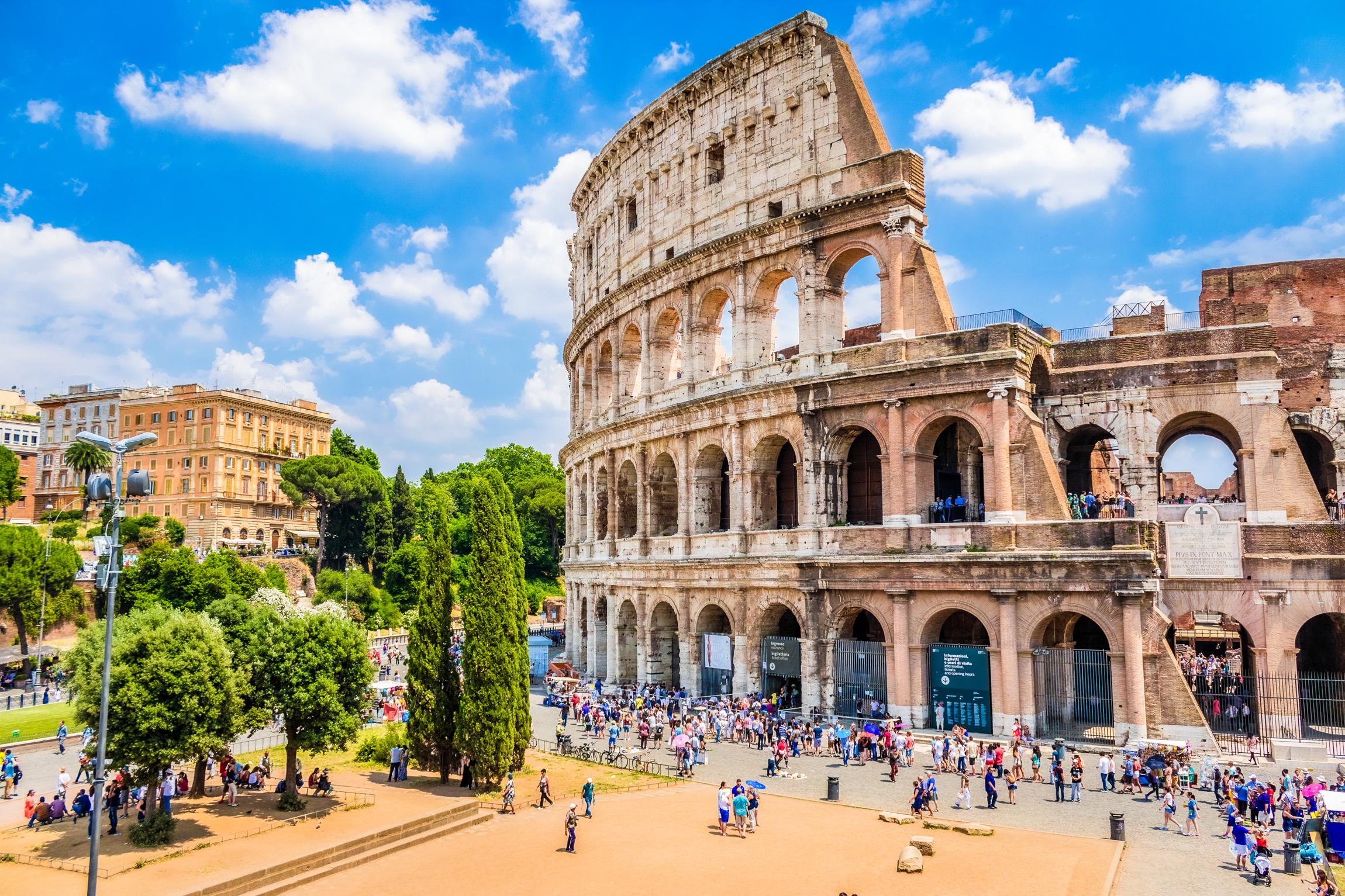
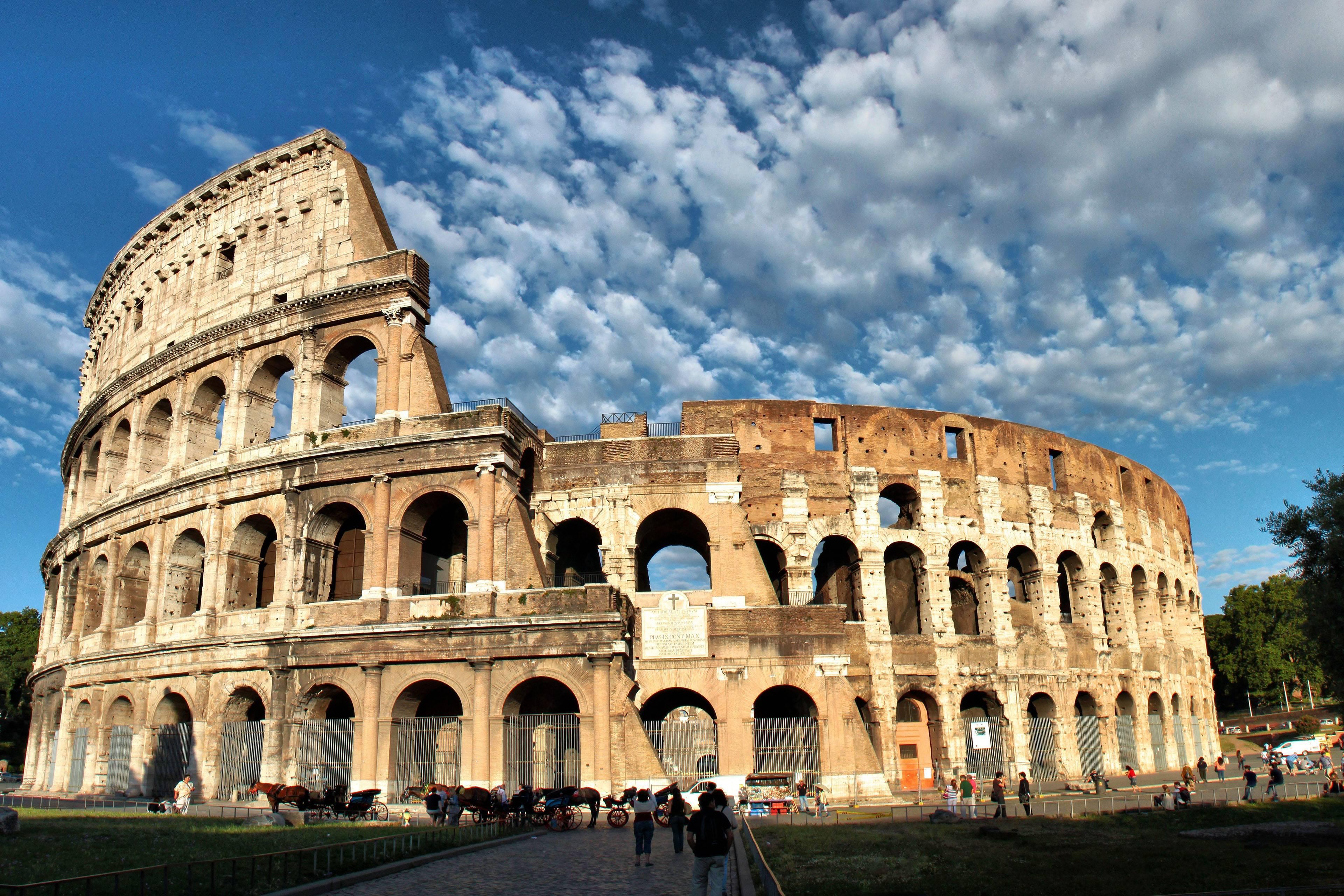
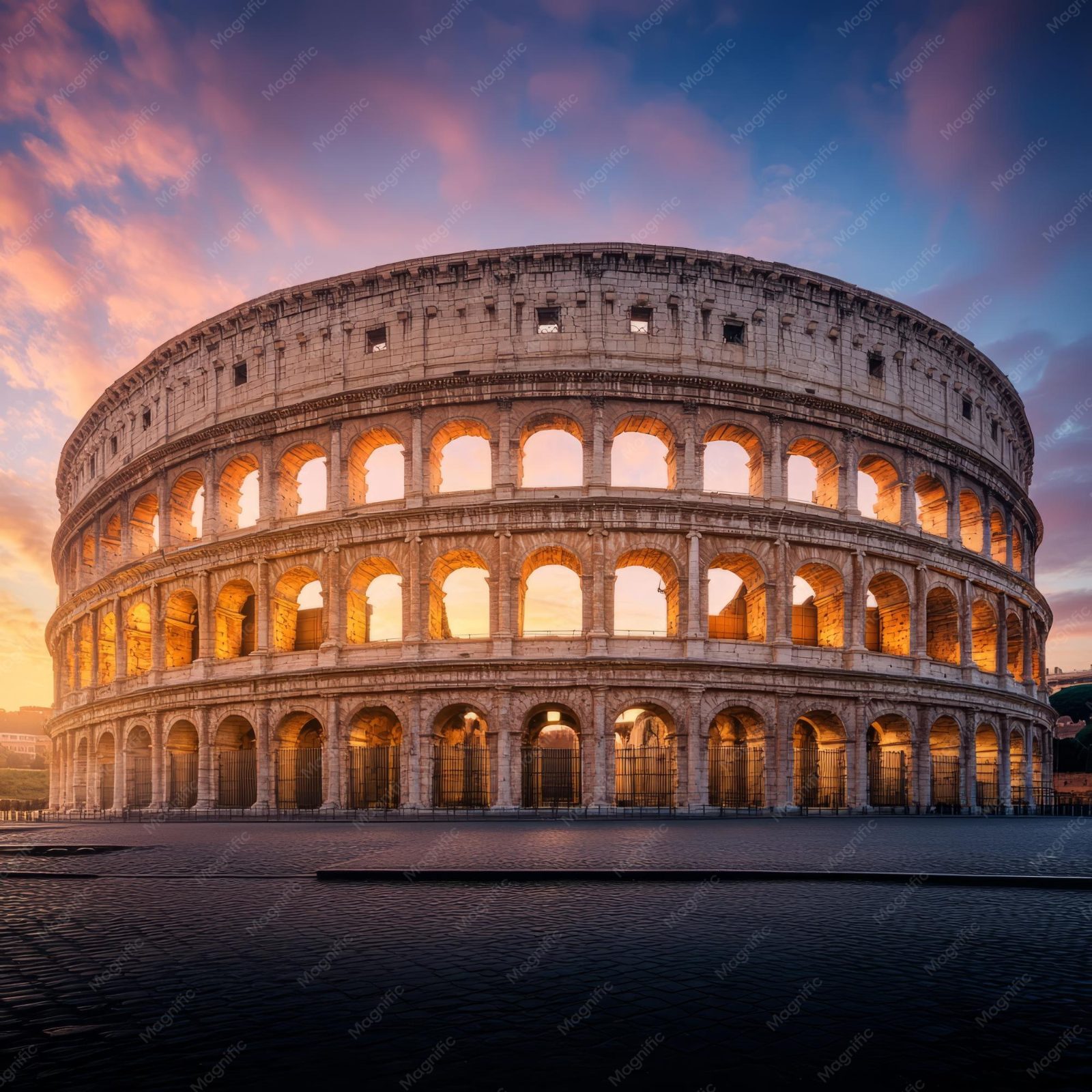
Travertine arcades at first light, one guide, one small circle.
Compare fares, pick the fit — all bookings are mobile-voucher and eligible for free cancellation where shown.
2 hr 30 min
3 hr
3 hr
For a colosseum private tour, the main choice is between the standard 24h entry, the arena-floor ticket, and the Full Experience ticket that adds the underground and expands the park access. If you want the most complete guided route, the official ticket that includes arena and underground is usually the best fit for a private visit.
| 24h Colosseum, Forum, Palatine Standard access (first and second order) | Only Arena Arena floor only, timed 20 minutes |
Top pick Full Experience Underground and Arena Arena plus underground, 2 days |
|
|---|---|---|---|
| Access included | Colosseum first and second order | Arena floor only | Colosseum, arena, underground |
| Underground access | — | — | |
| Arena floor access | — | ||
| Validity window | 24 hours | 24 hours | 2 consecutive days |
| Combined Forum/Palatine access | |||
| Reservation requirement | Book timed entry | Book timed entry | Book timed entry |
| See tickets & prices |
Verdict: First-time visitors should pick Full Experience Underground and Arena for the broadest official access, while budget-minded visitors can choose the 24h ticket and arena-focused visitors can use Only Arena; in short, colosseum private tour tours usually pair best with the Full Experience colosseum private tour tour, and simpler colosseum private tour tickets work when you only need the standard route.
Worth it for first-timers and archaeology buffs
The base entry is 18 EUR per person, and a colosseum private tour stacks a guide fee on top of that — usually several times the ticket price once you divide it across a small party. What you get for the premium is not access you couldn't otherwise buy; it's pacing and answers. A private guide reads the arena floor, the hypogeum edge, and the arcade tiers for you, adjusts when the amphitheatre gets dense, and fields the specific questions a headset commentary can't. That pays off hardest for first-time visitors to this Roman landmark, who otherwise stare at travertine without a frame, and for archaeology-focused travellers who want stone-by-stone detail rather than a script. Families with restless children get real value from the flexibility. Return visitors and confident self-guided readers rarely do — you already have the frame, and skip-the-line Colosseum access alone solves your main problem. Couples travelling as two absorb the worst cost-per-head maths; groups of four or more make private guiding tours of the Flavian Amphitheatre genuinely defensible. Compare the quoted guide fee against what a well-chosen book and the 18 EUR entry would give you.
Bottom line: Book the colosseum private tour tickets if you're arriving cold, curious, and splitting the fee three or more ways — otherwise the 18 EUR entry and your own reading will serve you just as well on this colosseum private tour tour of Rome's landmarks.
They complement each other, but most visitors who value live explanation and route flexibility find the private tour more engaging, while the official Full Experience visit is better for independent pacing across the Colosseum, Roman Forum, and Palatine Hill. A colosseum private tour gives you tighter interpretation; the self-guided option gives you broader ancient-city coverage with more control over when and how long you linger.
|
Top pick Private tour |
Official Full Experience | |
|---|---|---|
| Guiding style | Private guide, live commentary | Self-guided, app/audio support |
| Route control | Fully flexible pacing and stops | Reserved access, fixed entry time |
| Interpretation depth | Tailored answers, deeper context | App stories and route notes |
| Ancient city coverage | Colosseum-focused, custom add-ons | Colosseum, Forum, Palatine Hill |
| Pacing | Moves at your group’s speed | You set the pace independently |
| Best for | First-timers wanting personal context | Visitors wanting more sites and autonomy |
| See tickets & prices |
Verdict: Choose the private tour for the most personalized explanation, and choose the official Full Experience route if you want colosseum private tour tours-style independence with broader coverage across the archaeological park.
Hand-picked experiences loved by thousands of travelers
2 - 2.5 hours
Free Cancellation
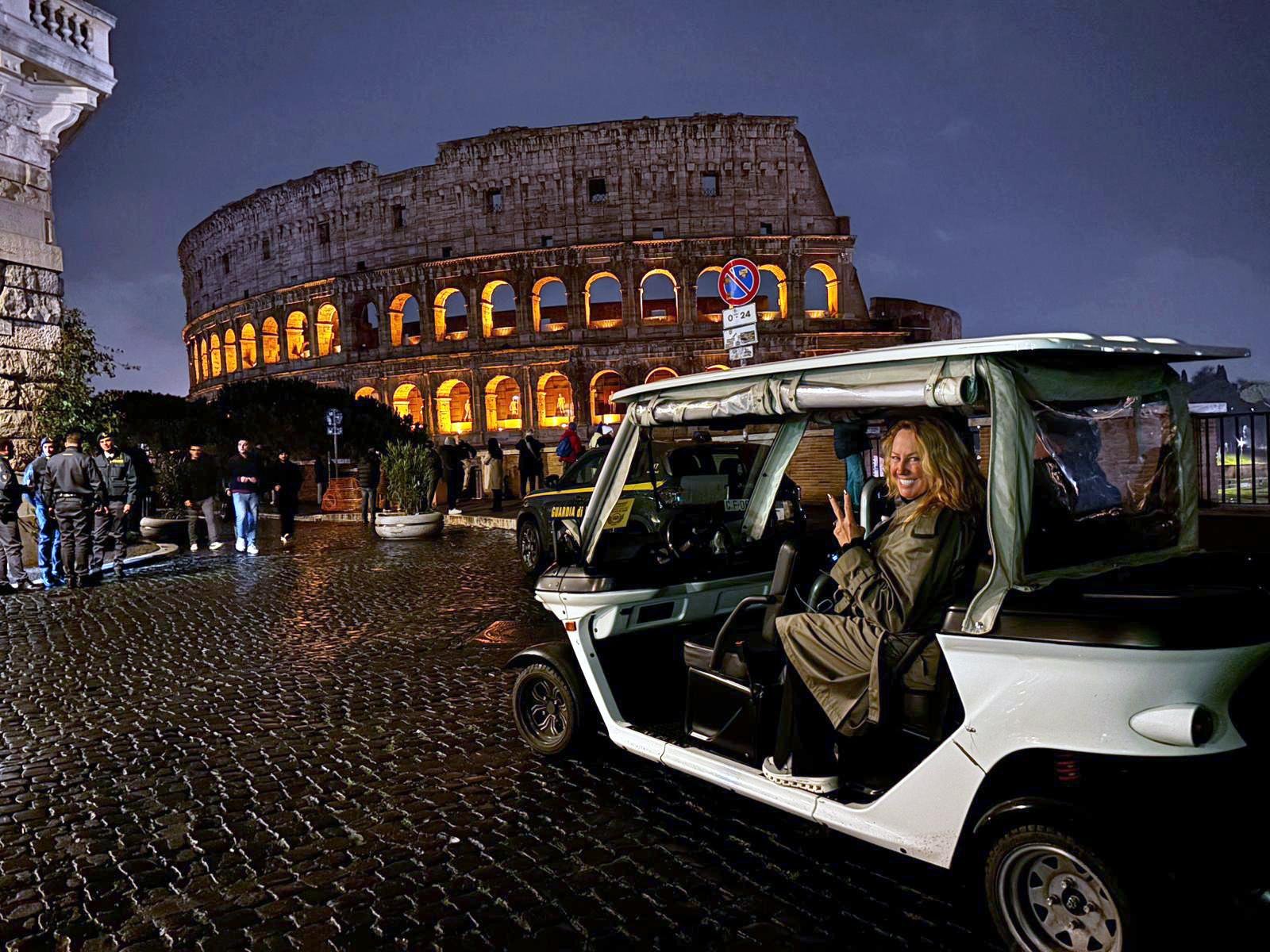
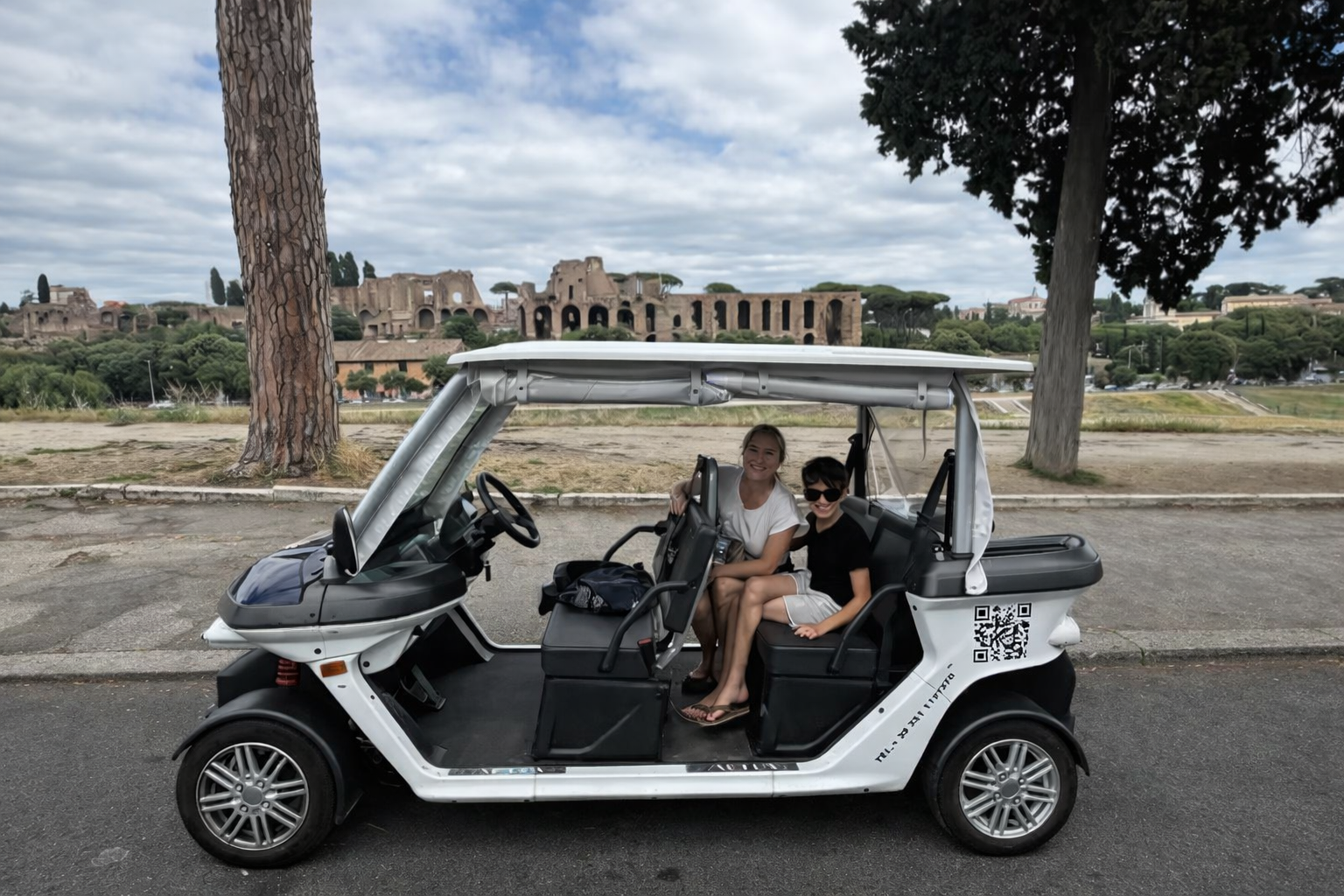
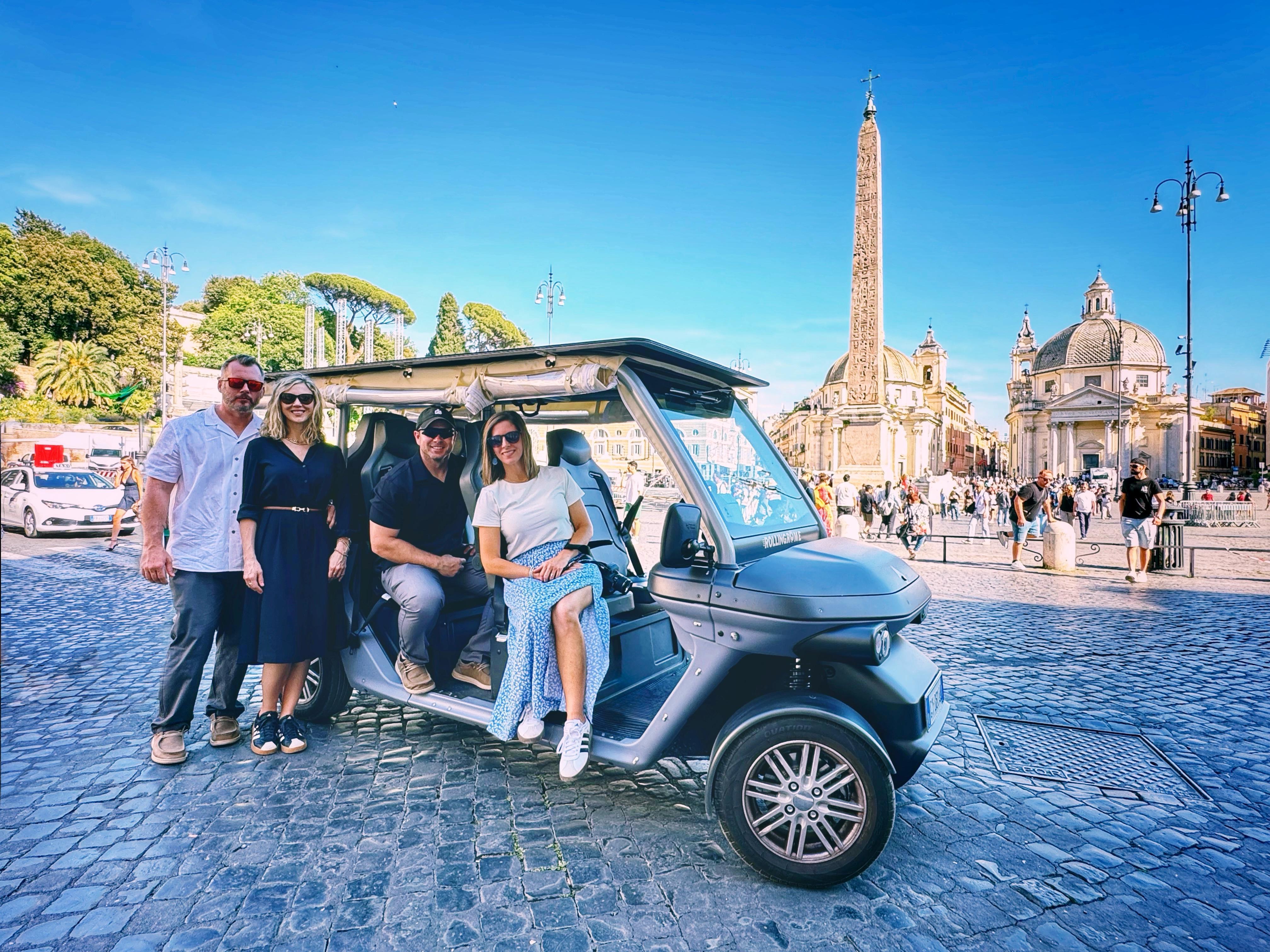
Glide through Rome's historic center in a private electric golf cart, with gelato breaks and iconic landmarks.
3 hours
Free Cancellation
Skip the lines with a private historian guide through the Colosseum, Roman Forum and Palatine Hill.
3 hours
Free Cancellation
Zip through Rome's iconic sights in a private golf cart with a local guide tailoring the route to you.
1.5 hours
Step onto the Colosseum's Arena Floor with a small group and an expert guide, exploring gladiator history up close.
2.5 - 3 hours
Free Cancellation
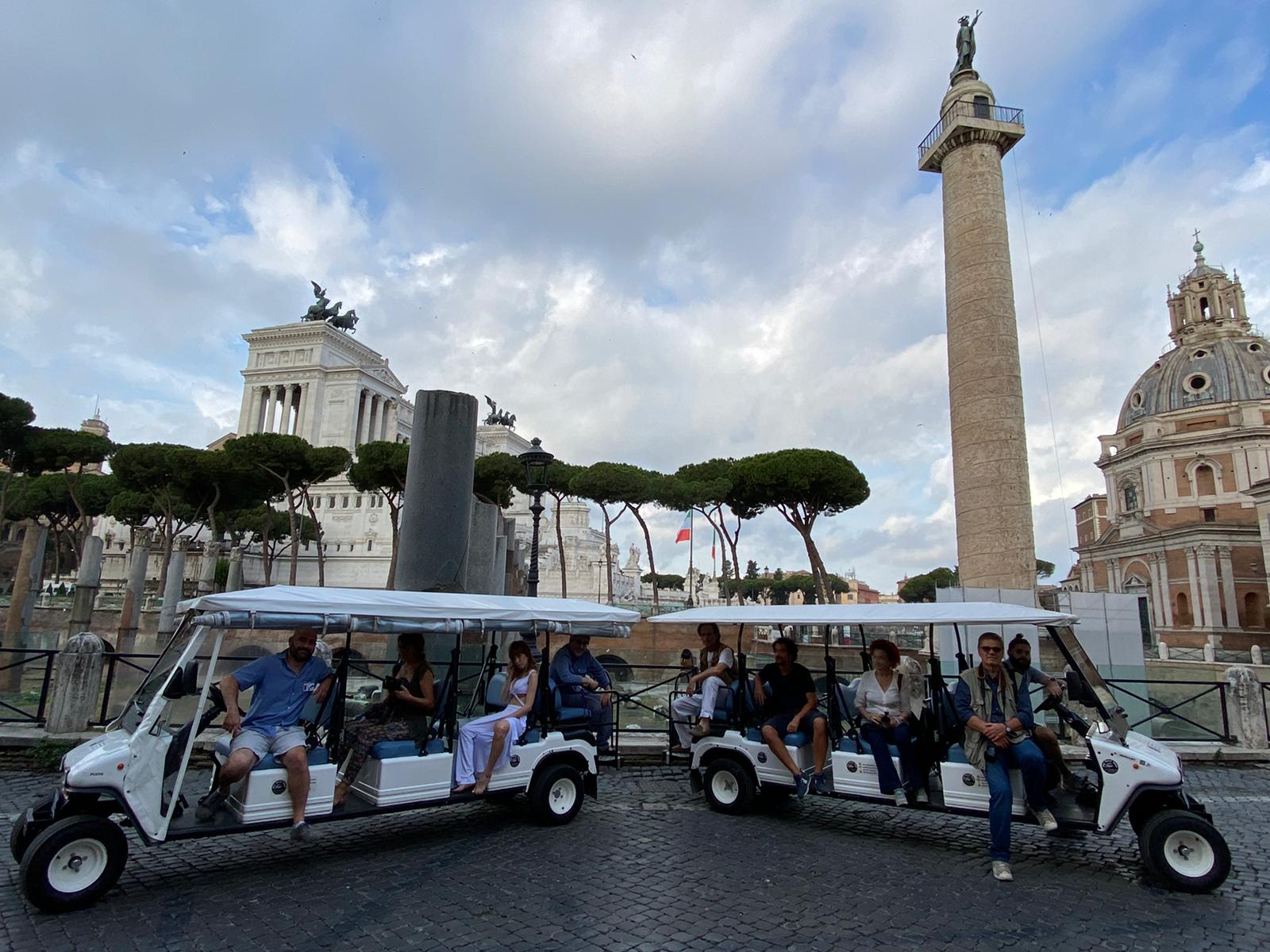
Zip through Rome's icons and hidden corners on a private, driver-guided golf cart ride.
2.5 - 3 hours
Skip the line and step onto the Colosseum Arena floor, then explore the Roman Forum and Palatine Hill.
3 - 3.5 hours
Free Cancellation
Go behind the scenes at the Colosseum's underground and explore the Roman Forum with a private guide.
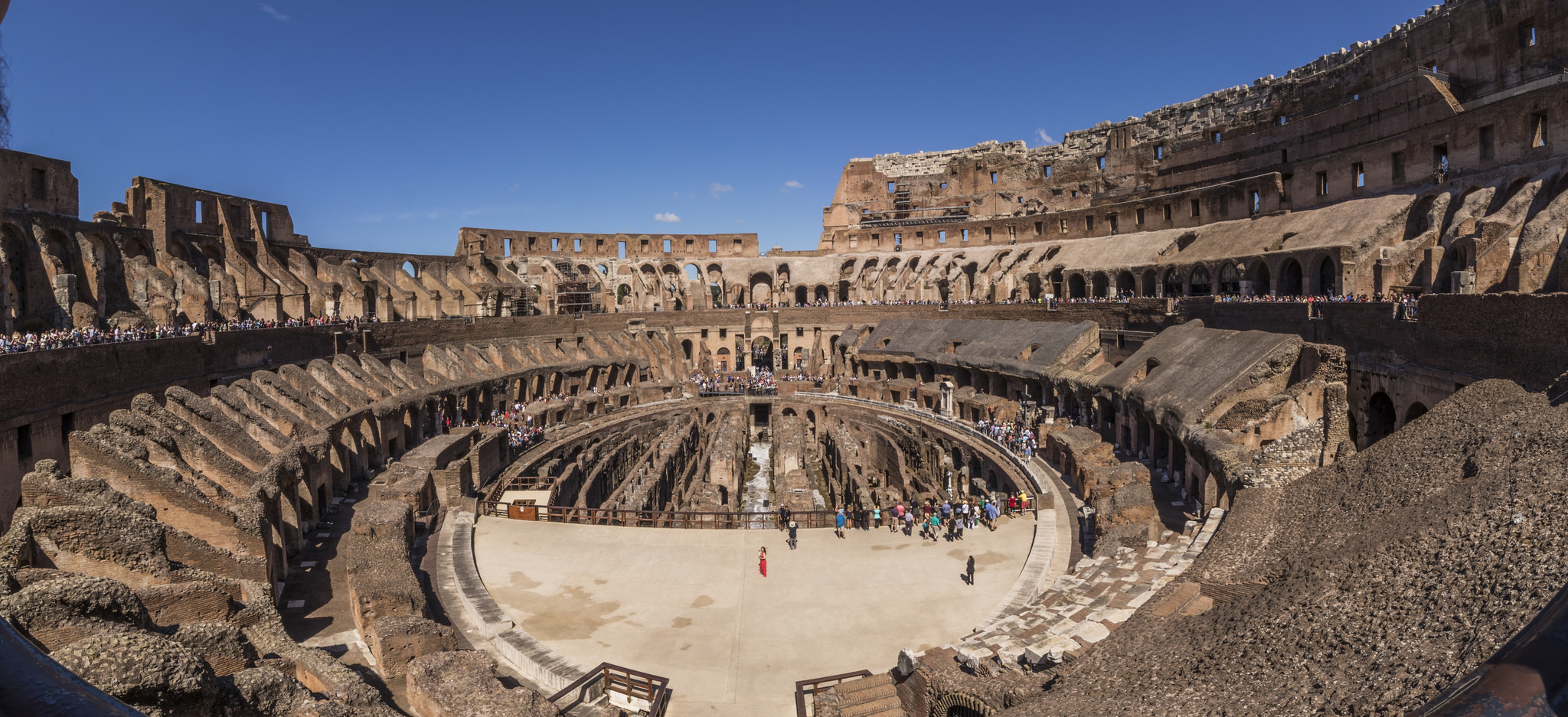
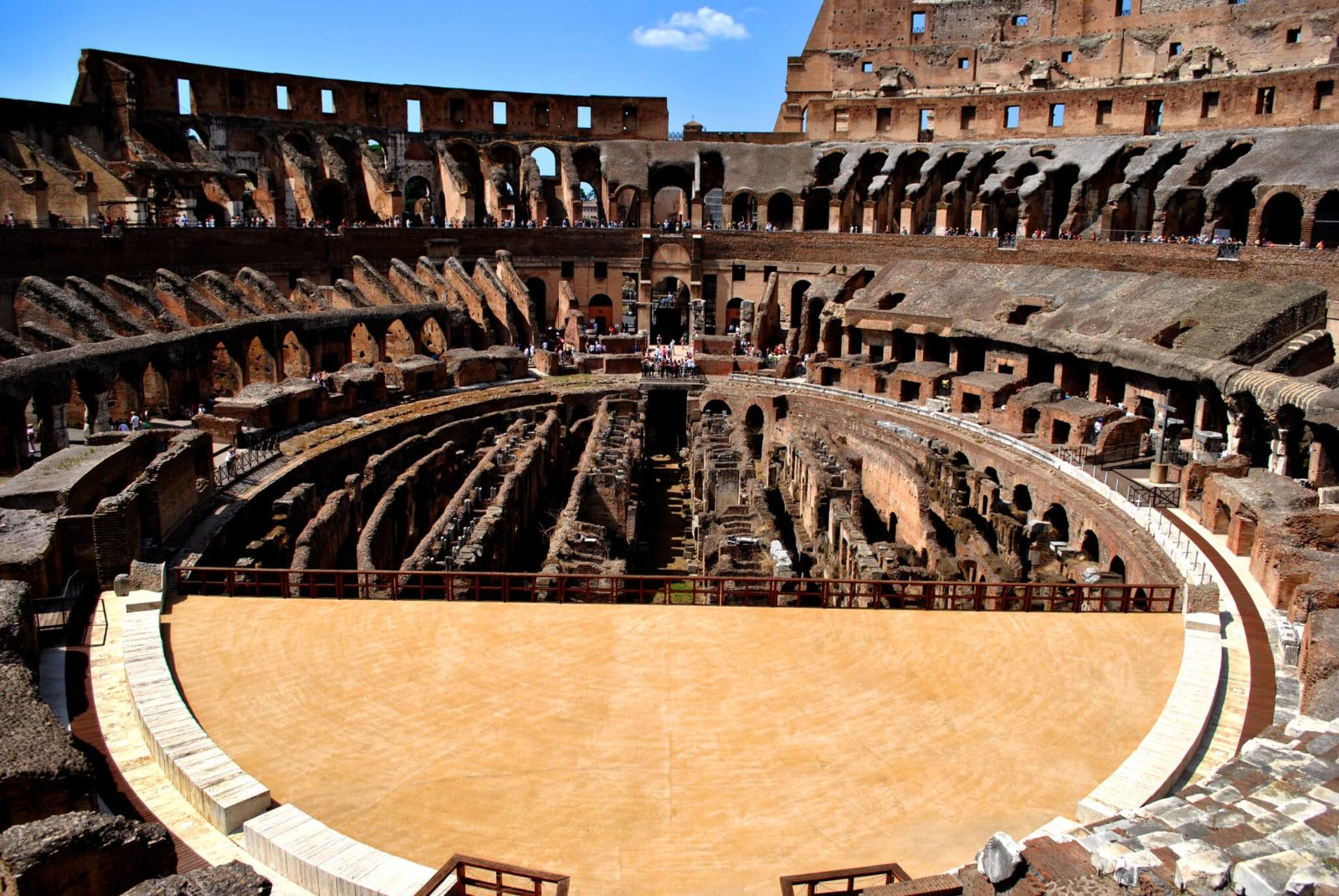
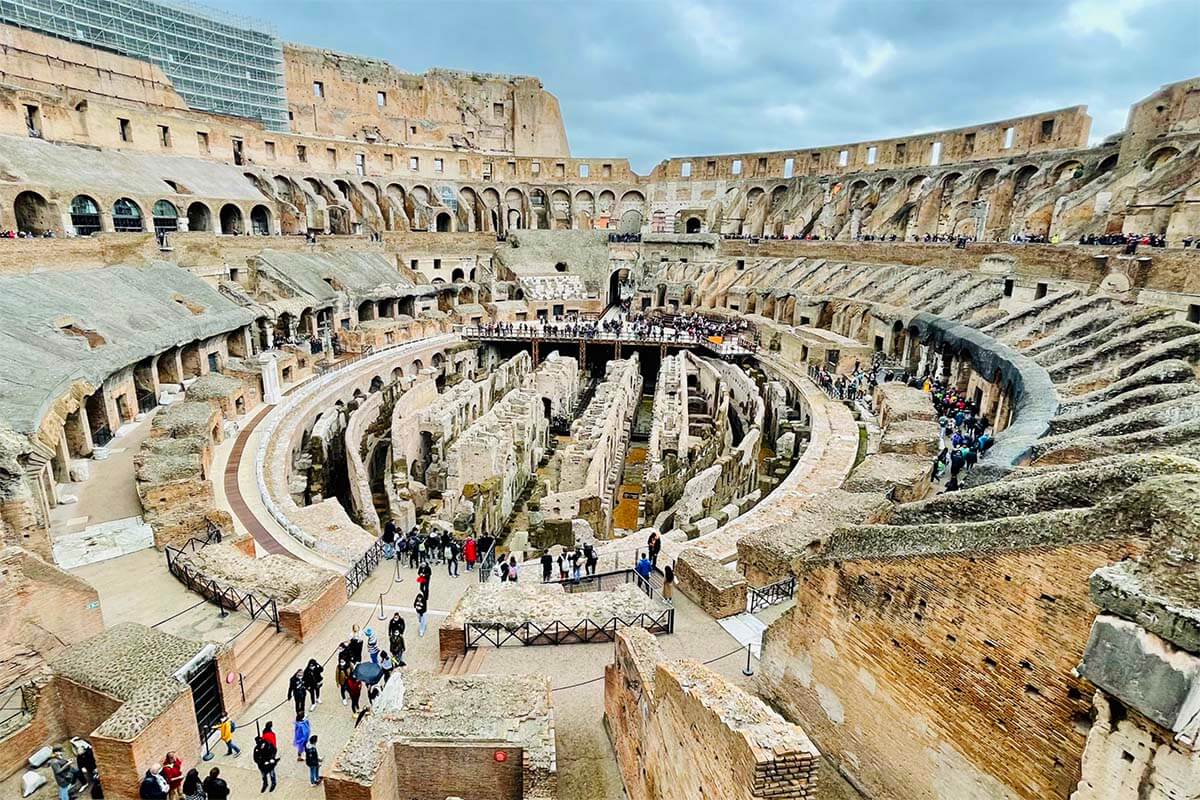
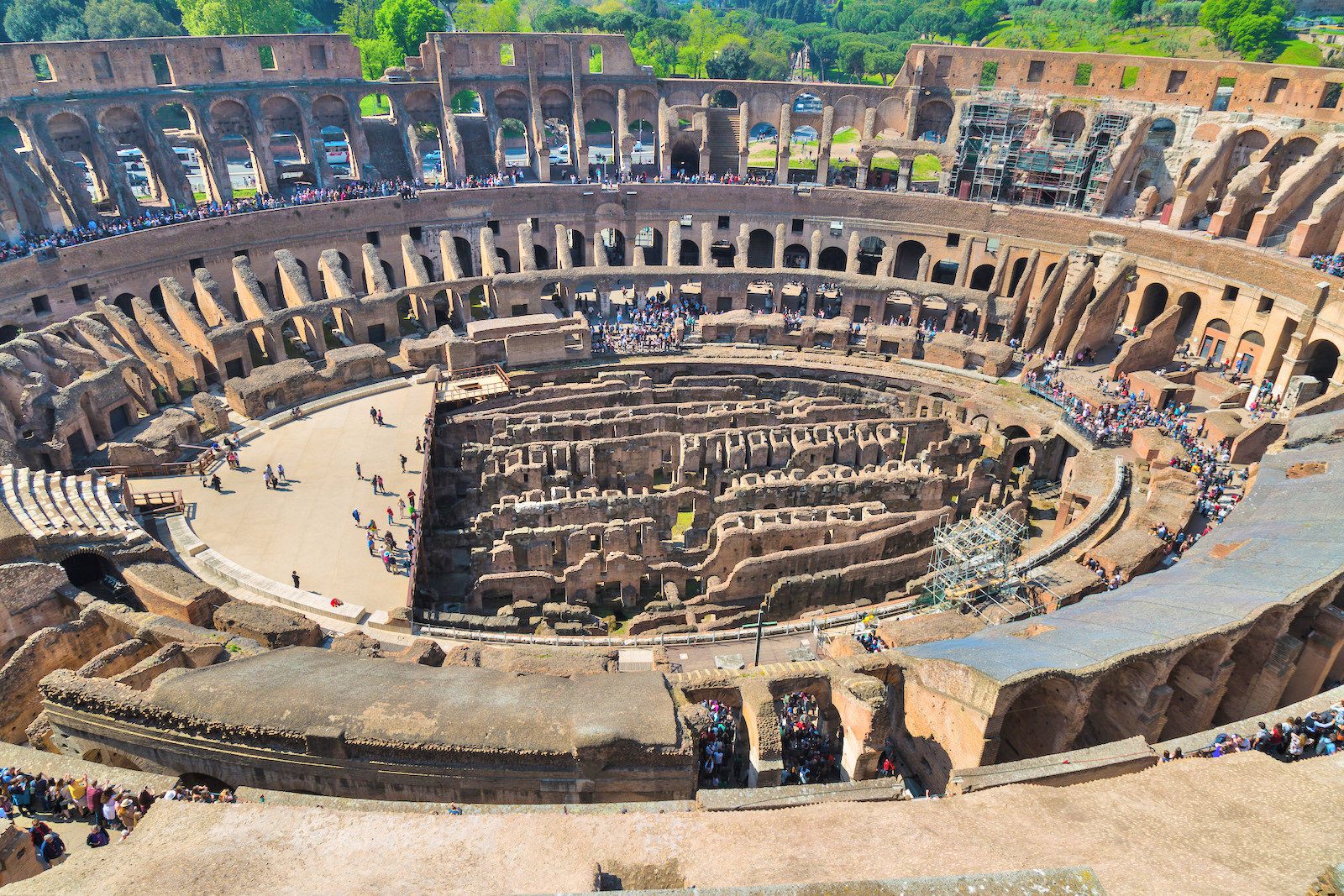
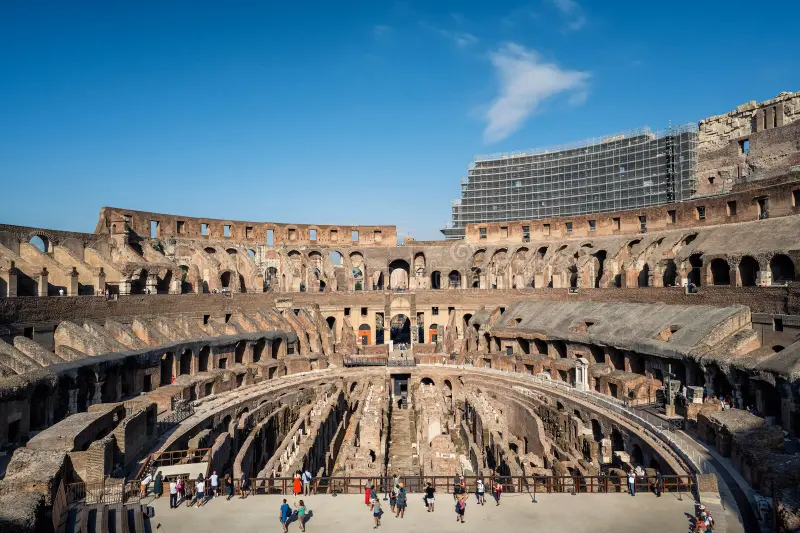
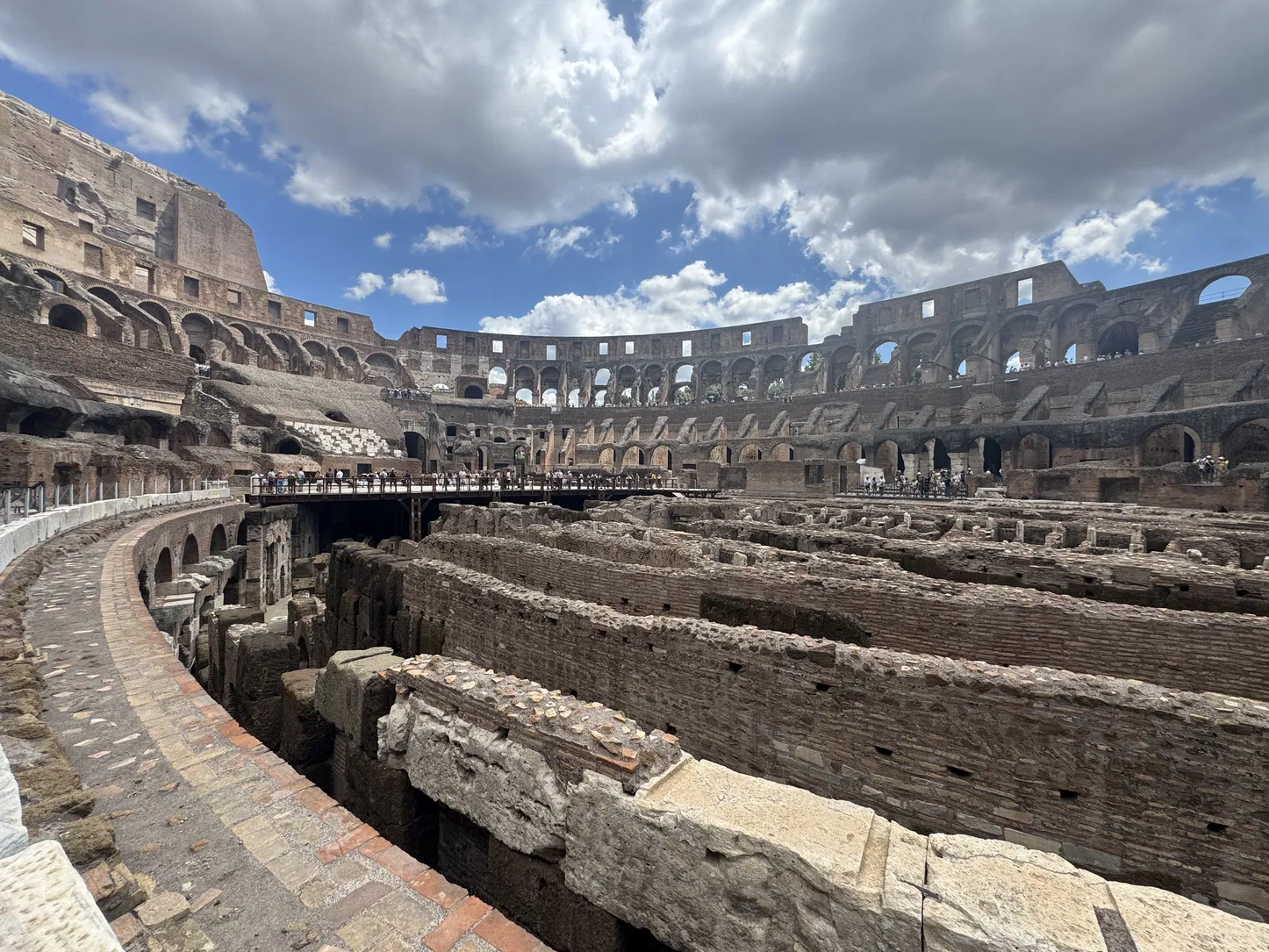
The arena floor is the most direct way to read the Colosseum as a performance space. From here, you can appreciate how roughly 50,000 spectators were organized in tiers around the action, and why a private route changes the feel of the monument.
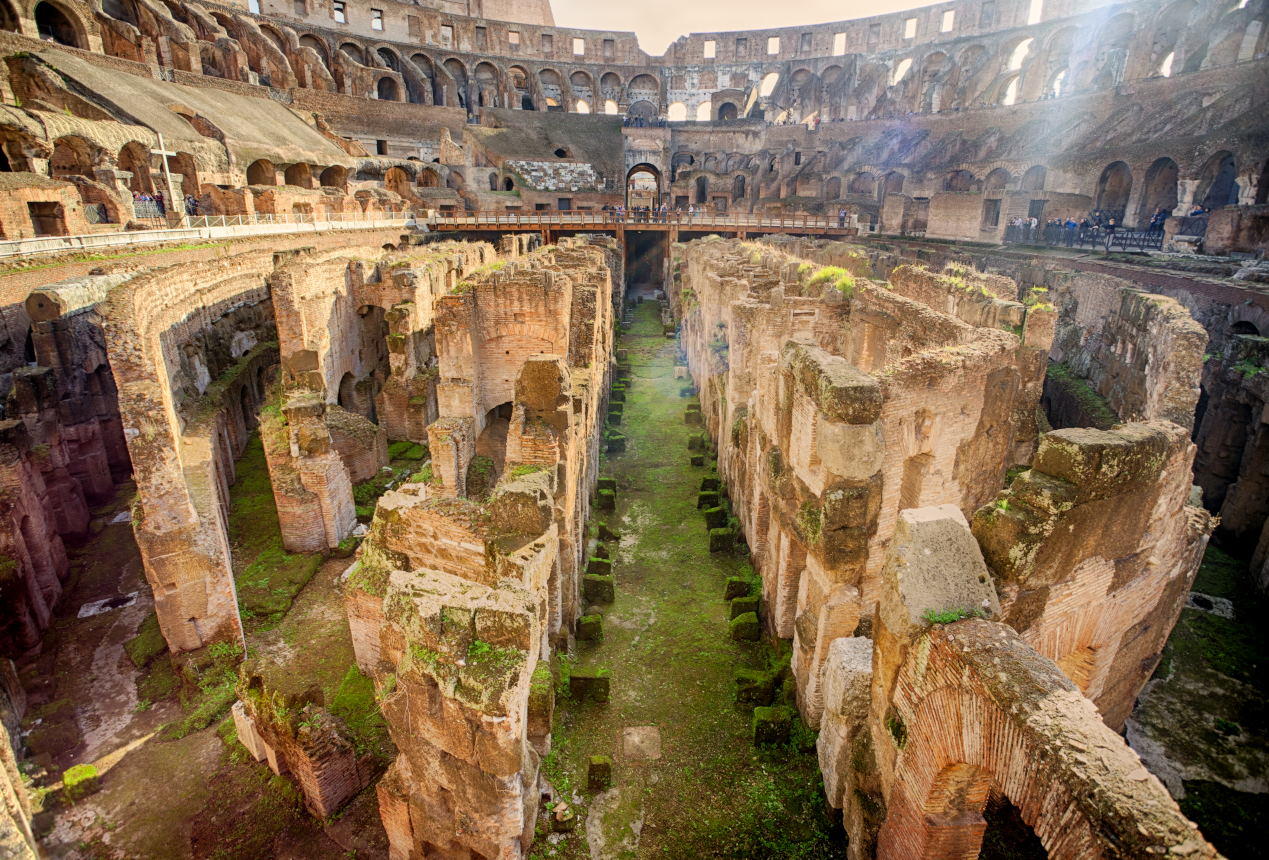
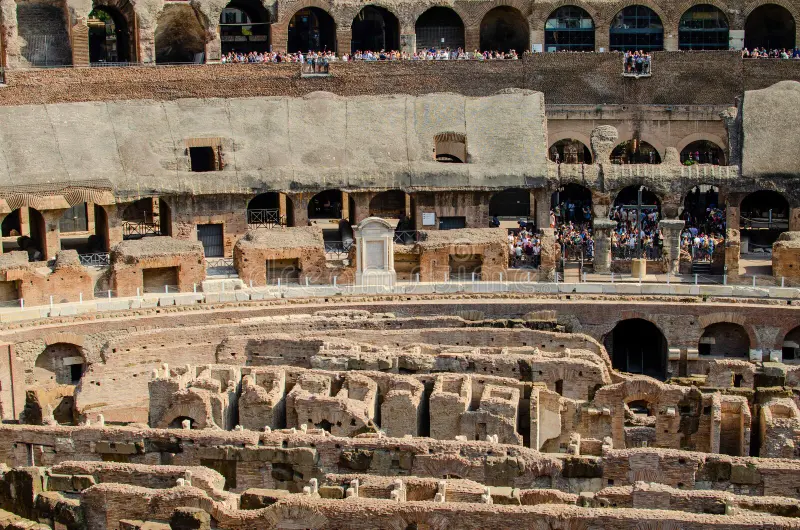
The underground hypogeum held lifts, corridors, and staging systems that supported the shows above. It is one of the clearest places to understand the machine-like logistics behind the amphitheater, where rapid scene changes were built into the architecture.
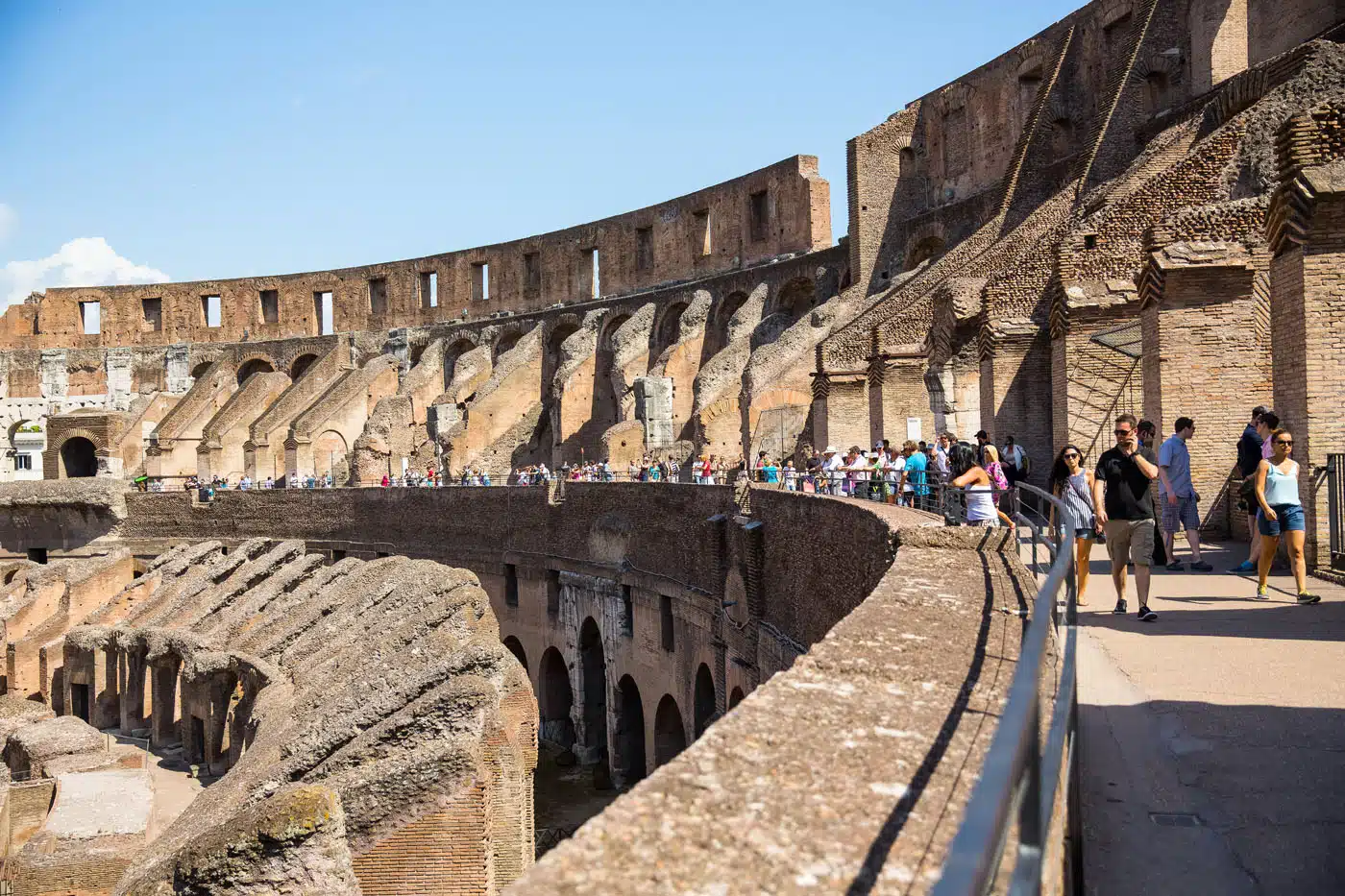
The first-tier arcades preserve the rhythm of the outer ring and its repeated arches. Their structure shows how Roman engineering balanced load, circulation, and dramatic scale in a single façade.
The second-tier gallery gives a strong sense of vertical movement through the monument. It also links directly with accessible routes, making it one of the most practical and informative levels to visit closely.
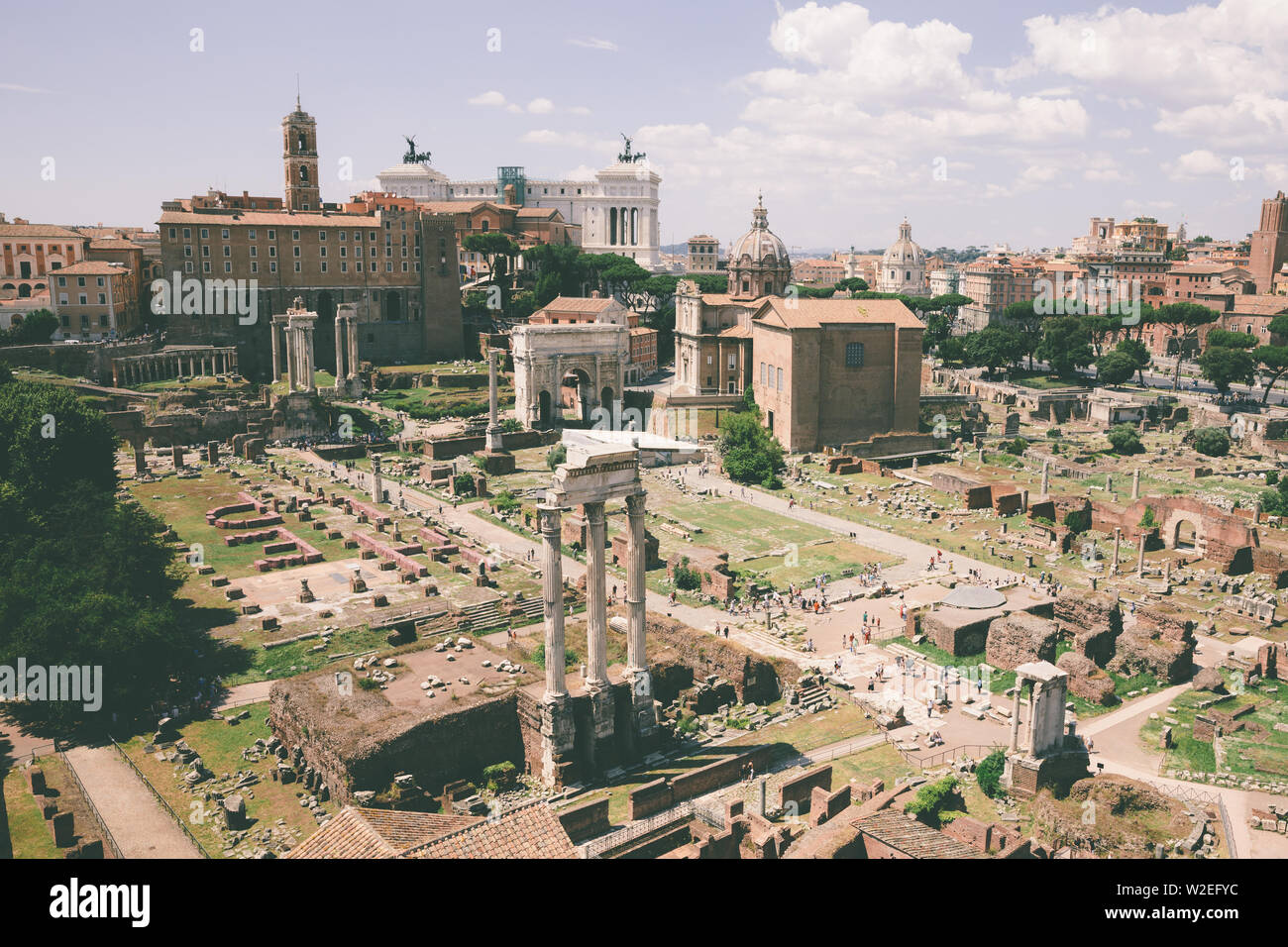
The park’s belvedere areas frame the amphitheater against the Roman skyline. They are useful for understanding how the Colosseum relates to the Forum, Palatine Hill, and the broader archaeological landscape.
The Triumphalis Gate marks one of the ceremonial access points used in the monument’s circulation system. It helps explain how movement through the building was organized for both spectacle and controlled entry.
You meet your guide on the paving outside Piazza del Colosseo, 1, and the arcades are already catching the low sun. Doors open at 08:30, and arriving between 08:30 and 09:30 buys you cooler air and thinner queues before the coaches unload.
Standard adult entry runs 18 EUR per person; on a private colosseum tour with arena floor access, your guide handles the checkpoint while you look up at the numbered arches.
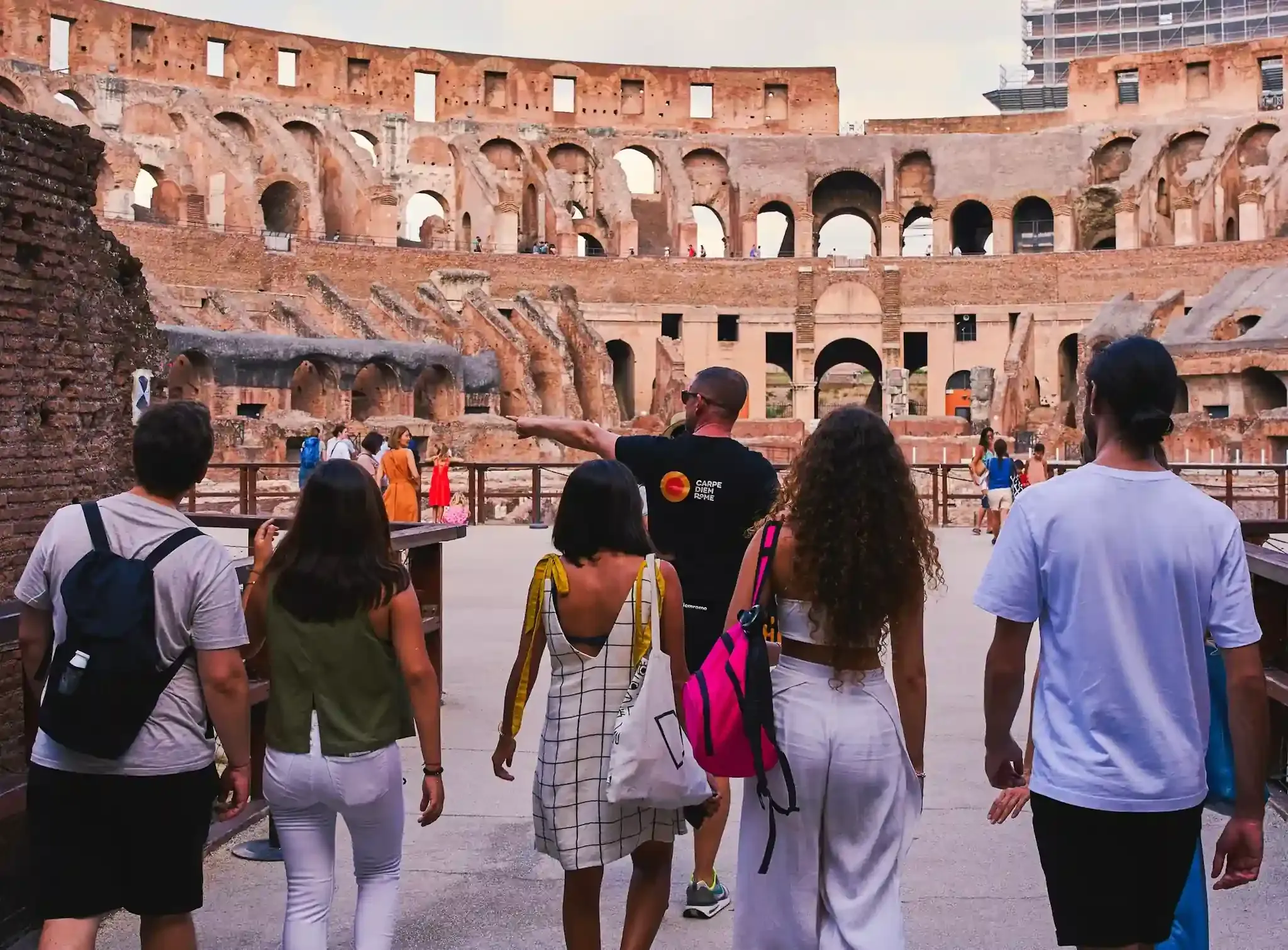
You pass through the outer corridor, then climb to the first tier. Your guide points across the ellipse — 189 metres on its long axis, 156 on the short — and traces where the senators sat and where the awning masts once stood. You stop at a section of restored seating and put your hand on the travertine, warm already. Below you, the hypogeum opens as a maze of brick spines.
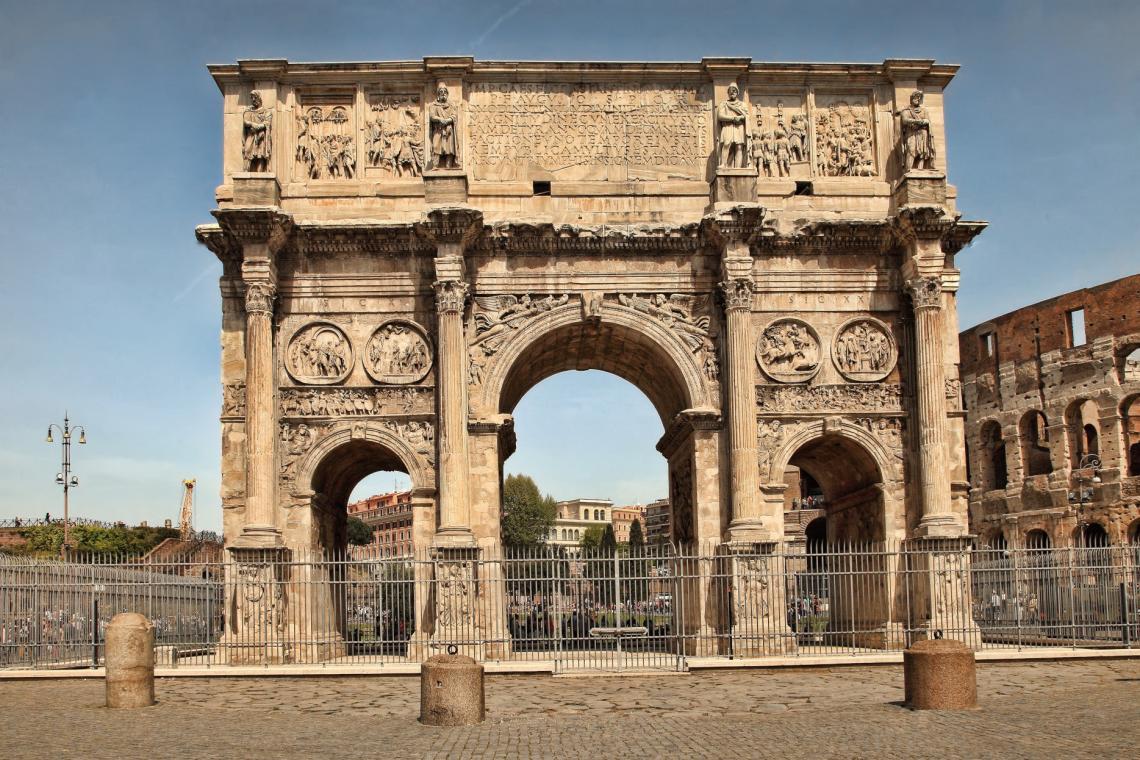
On the arena platform you stand at ground level for the first time, facing the tiers as a combatant would have. Then you walk out under the Arch of Constantine and continue into the Roman Forum, past the Temple of Vesta, before climbing the Palatine for the view back over the whole ancient city. Your guide leaves you there, and you finish the morning under the pines.
All the details about your upcoming adventure in one place
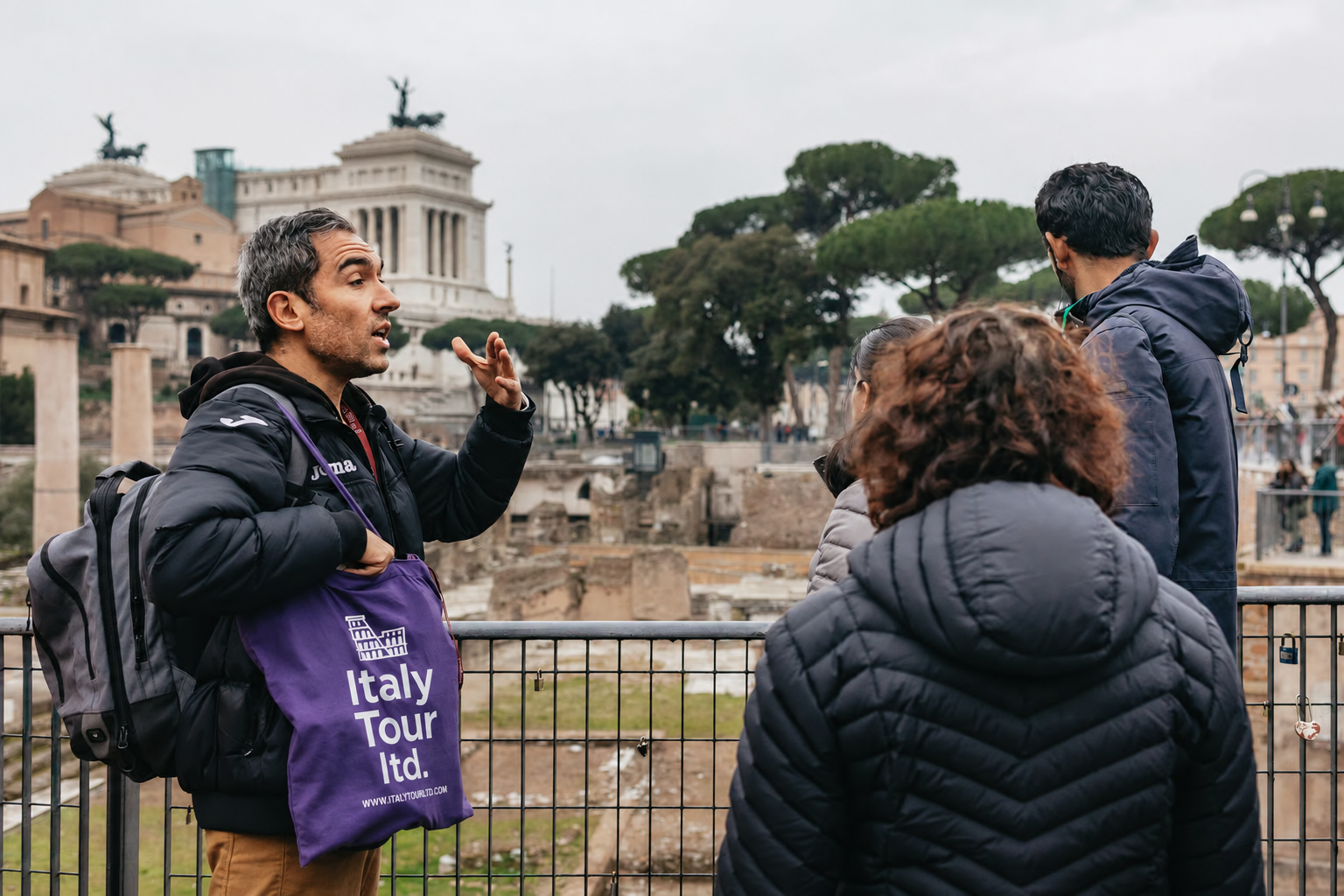
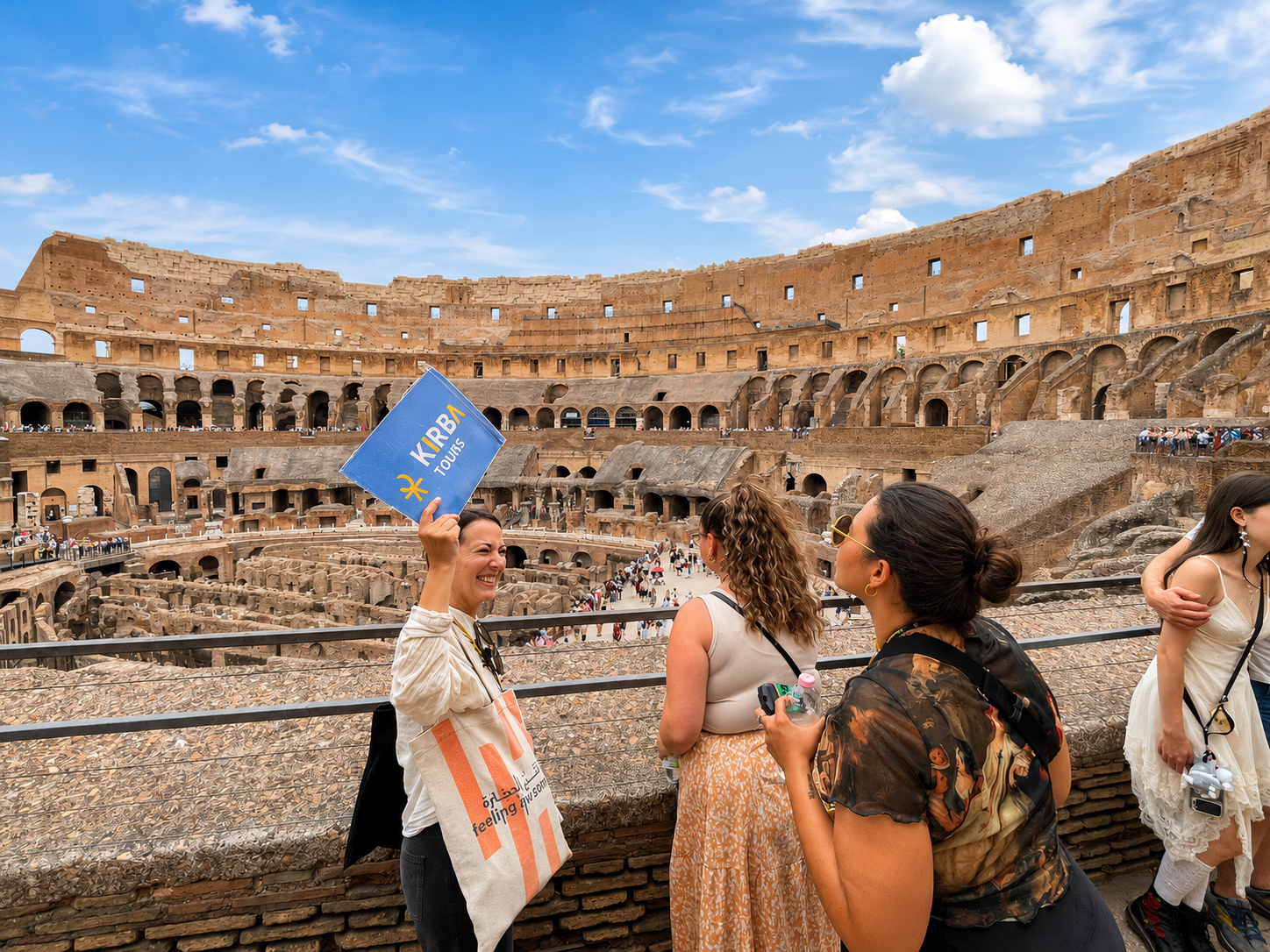
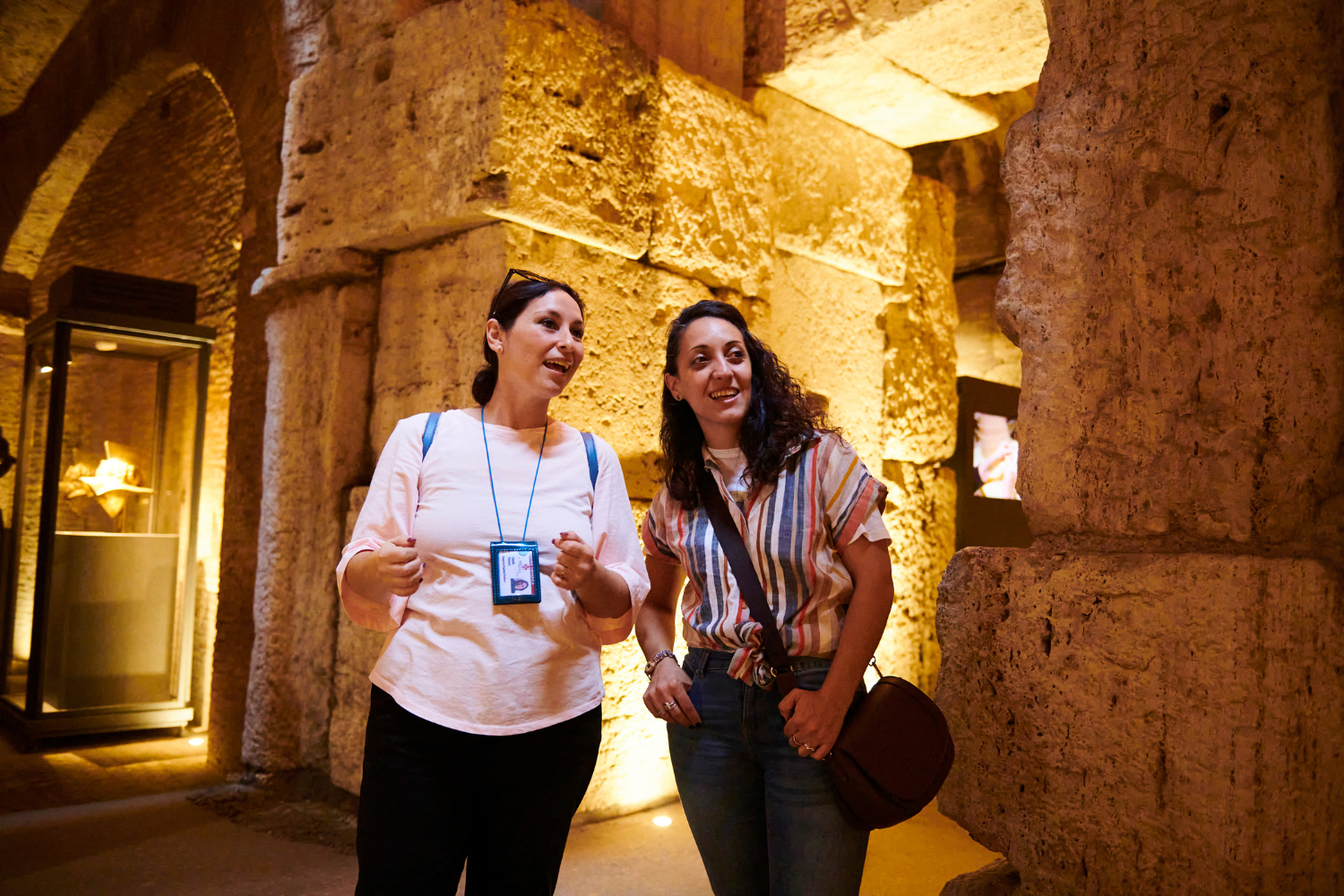
A colosseum private tour pairs you with one licensed guide who leads only your group through the arena's tiered seating, the surviving travertine arcades, and across the Roman Forum toward the Palatine Hill. Because colosseum private tour tickets are booked as a closed group, your guide adapts the pace and lingers wherever your curiosity goes — the hypogeum corridors, the Flavian dynasty's ambitions, or the acoustics of the upper tiers. Guests who have joined other Rome landmarks outings often note the difference: fewer voices competing, more room for real questions.
The Flavian Amphitheatre was built on a drained artificial lake, the ornamental centrepiece of Nero's confiscated palace grounds. Vespasian began the work around AD 72; his son Titus inaugurated it in AD 80.
That gesture — turning a private pleasure lake into a public arena — explains the building's shape and its politics at once.
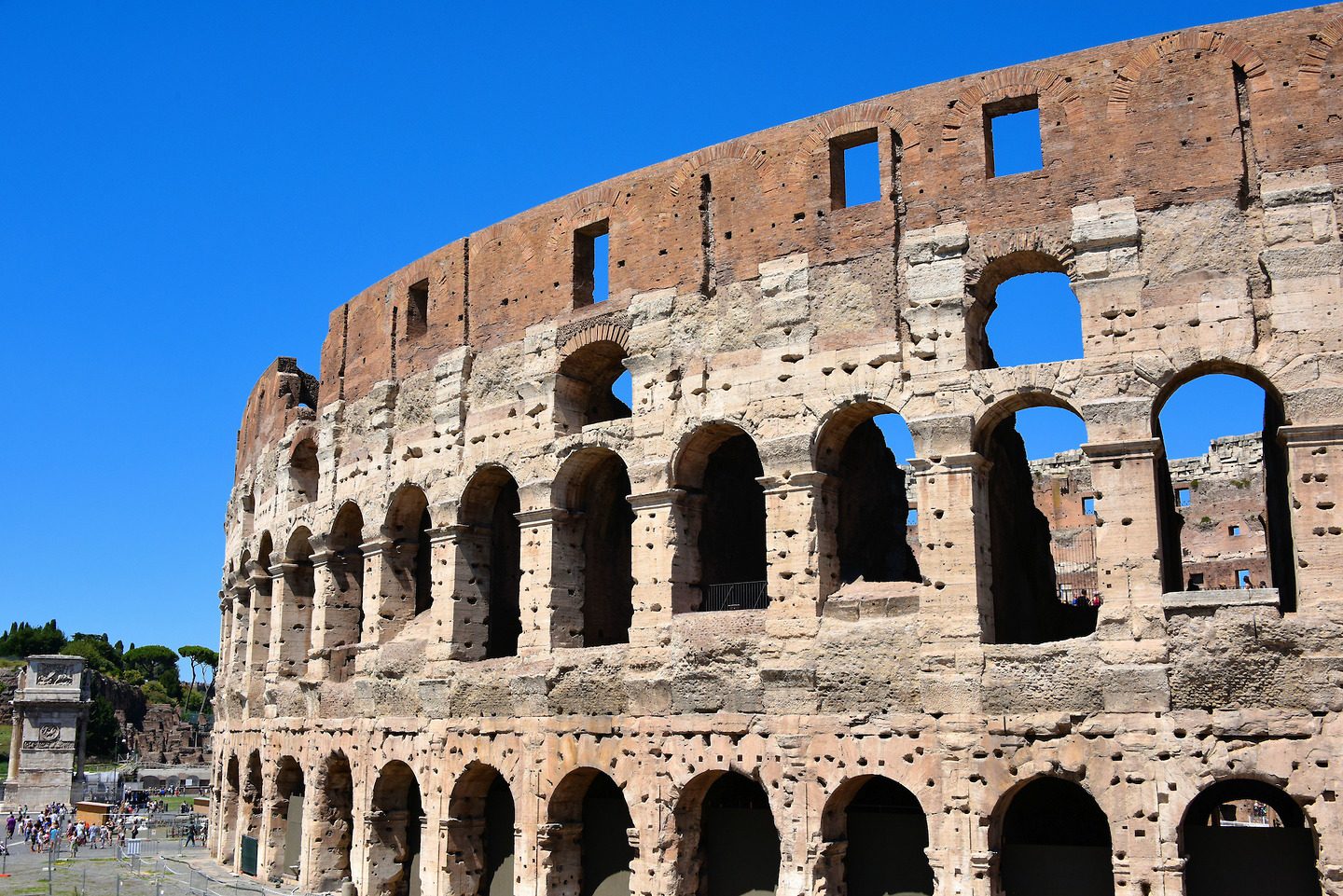
Eighty arched entrances once fed a crowd estimated between 50,000 and 70,000 people. The tiers stack the classical orders in sequence: Doric at ground level, Ionic above, Corinthian higher still, with a solid attic storey capped by brackets that once carried the masts of the velarium, the retractable awning worked by sailors from the imperial fleet at Misenum. The fabric is travertine from Tivoli, quarried and hauled twenty miles, held originally by iron clamps. The pockmarks visible across the façade are the scars left when those clamps were prised out in the medieval centuries. Concrete and brick-faced vaulting carried the load; the corridor system beneath the seating remains one of the clearest surviving lessons in Roman crowd engineering.
What a colosseum private tour offers today is proportion. A guide moving with six people rather than sixty can stop at a single numbered entrance arch and explain how a ticket in terracotta sent a spectator to a fixed seat by rank. Visitors searching colosseum private tour underground, or trading notes about colosseum private tour reddit threads, are usually chasing that same quality of attention. Rome landmarks tours that pair the amphitheatre with the Roman Forum and Palatine Hill place it in its civic sequence rather than isolating it as a monument.
The structure has survived earthquakes, quarrying for the Palazzo Venezia and St Peter's, and centuries of use as workshops and chapels. Its 1980 UNESCO listing, shared with the historic centre of Rome, formalised what pilgrims and antiquarians had assumed for a millennium. Conservation continues in phases, with cleaning of the northern façade and stabilisation of the hypogeum walls among recent campaigns.
Good colosseum private tour tours read the building rather than recite it — the seating hierarchy, the drainage channels, the marble that is no longer there. Anyone weighing colosseum private tour cost against a general-admission ticket is really weighing depth of interpretation, and colosseum private tour tickets are sold on that basis.
The pockmarks across the travertine are not decay but theft — the scars of iron clamps prised out over medieval centuries.
Dress for uneven stone, stairs, and warm summer conditions inside the Colosseum Archaeological Park. Comfortable closed-toe walking shoes are the safest choice, and a hat or light layers help for exposed sections of the route.
Security screening is mandatory at entry, and the park requires a valid ticket and ID to remain visible on request. Keep bag contents simple because large items slow down screening and some underground or upper-level access routes are more constrained than the main floor.
Personal photography is allowed in visitor areas, but tripods, drones, and flash use in sensitive interiors can be restricted by staff. Follow on-site instructions around the arena, underground access, and exhibition spaces, where flow control is tighter.
Families can use the park’s nursery-oriented services and rest areas, but the route is still long, uneven, and exposed in parts. Younger children do better with an early-morning visit, light carry items, and a pacing plan that includes the Forum and Palatine only if energy remains.
The Colosseum has an accessible route covering most of the first tier and, via dedicated elevators, the whole second tier. The park also provides accessible restrooms, wheelchair availability at some entrances, and multiple accessible entry points for visitors with reduced mobility.
Eating is not the focus inside the monument, so plan meals before or after the visit rather than relying on the site for full-service dining. Water is especially important in summer because the amphitheater, Forum edge, and surrounding square can feel hot and reflective.
Opening hours
Monday–Sunday: 08:30–19:15
Address
Piazza del Colosseo, 1, 00184 Roma RM, Italy
Mobility access
Elevators reach the second tier; accessible paths cover most of the first tier
Best arrival window
08:30–09:30 for fewer crowds and cooler morning conditions
Official site
https://colosseo.it/en/opening-times-and-tickets/
Admission tickets are timed and generally non-refundable once issued unless the seller’s terms allow a change or cancellation. The official booking system opens sales 30 days before the visit date, and the standard adult entrance fee is 18 EUR per person.
Recommended time
2-3 hours
A colosseum private tour usually works best in a 2-3 hour block: about 60-90 minutes inside the Colosseum, plus time to move through security, brief stops on the route, and any extra discussion with your guide. If your plan includes the Roman Forum or Palatine afterward, add another 1-2 hours. Queue reality is simple: even with a private guide, entry checks and timed access can slow things down, so a smooth start matters more than squeezing the schedule.
Crowd levels through the day
Construction began around AD 72 under Vespasian, first emperor of the Flavian dynasty. The site was deliberate. Nero's private lake, part of the Domus Aurea, was drained and filled to make room. The gesture returned seized land to the Roman people. Titus inaugurated the amphitheatre in AD 80 with games lasting one hundred days. Domitian completed the upper tier and the subterranean works shortly after. Its Roman name was the Amphitheatrum Flavium; the modern label derives from the colossal statue of Nero that once stood nearby. Travertine from Tivoli, tufa, brick-faced concrete, and iron clamps formed a structure holding perhaps 50,000 spectators. Eighty entrance arches and a numbered ticket system, the tessera, emptied the tiers quickly. Visitors on a colosseum private tour still trace those numbered vaults today. Beneath the wooden arena floor lay the hypogeum, two storeys of corridors, cages, and shafts. Around thirty capstans hauled counterweighted lifts carrying animals and scenery to trapdoors above. The velarium, a retractable awning worked by sailors from the Misenum fleet, shaded the seating. Gladiatorial combat ended in the fifth century; animal hunts persisted until roughly AD 523 under Theodoric. Earthquakes in 443, 1231, and above all 1349 collapsed the southern outer ring. Stone was then quarried for palaces and churches, and the interior housed workshops and shelters. Access to the underground remains the reason many book a colosseum private tour tour rather than a general admission visit. Pope Benedict XIV consecrated the arena to the Passion in 1749, halting demolition. Nineteenth-century engineers added the brick buttresses of 1806 and 1827 that still hold the eastern and western ends upright. Excavation of the hypogeum, begun in the 1810s and completed under Mussolini in the 1930s, exposed the machinery now visible. A restoration campaign running from 2013 to 2016 cleaned the travertine façade, and the reconstructed arena floor project has continued through 2026. Guided colosseum private tour tours and skip-the-line Colosseum access route visitors through the gladiator gate and lower corridors. Among Rome landmarks, this UNESCO World Heritage monument records its own repairs as plainly as its games, and colosseum private tour tickets remain the common way to see them.
Vespasian begins construction on the drained lake of Nero's Domus Aurea.
Titus inaugurates the amphitheatre with one hundred days of games.
The last recorded animal hunts take place under Theodoric.
A major earthquake collapses the southern stretch of the outer ring.
Benedict XIV consecrates the arena, ending its use as a quarry.
Stern and Valadier add the brick buttresses that still brace both ends.
Fascist-era excavation fully clears the hypogeum beneath the arena.
A restoration campaign cleans and consolidates the travertine façade.
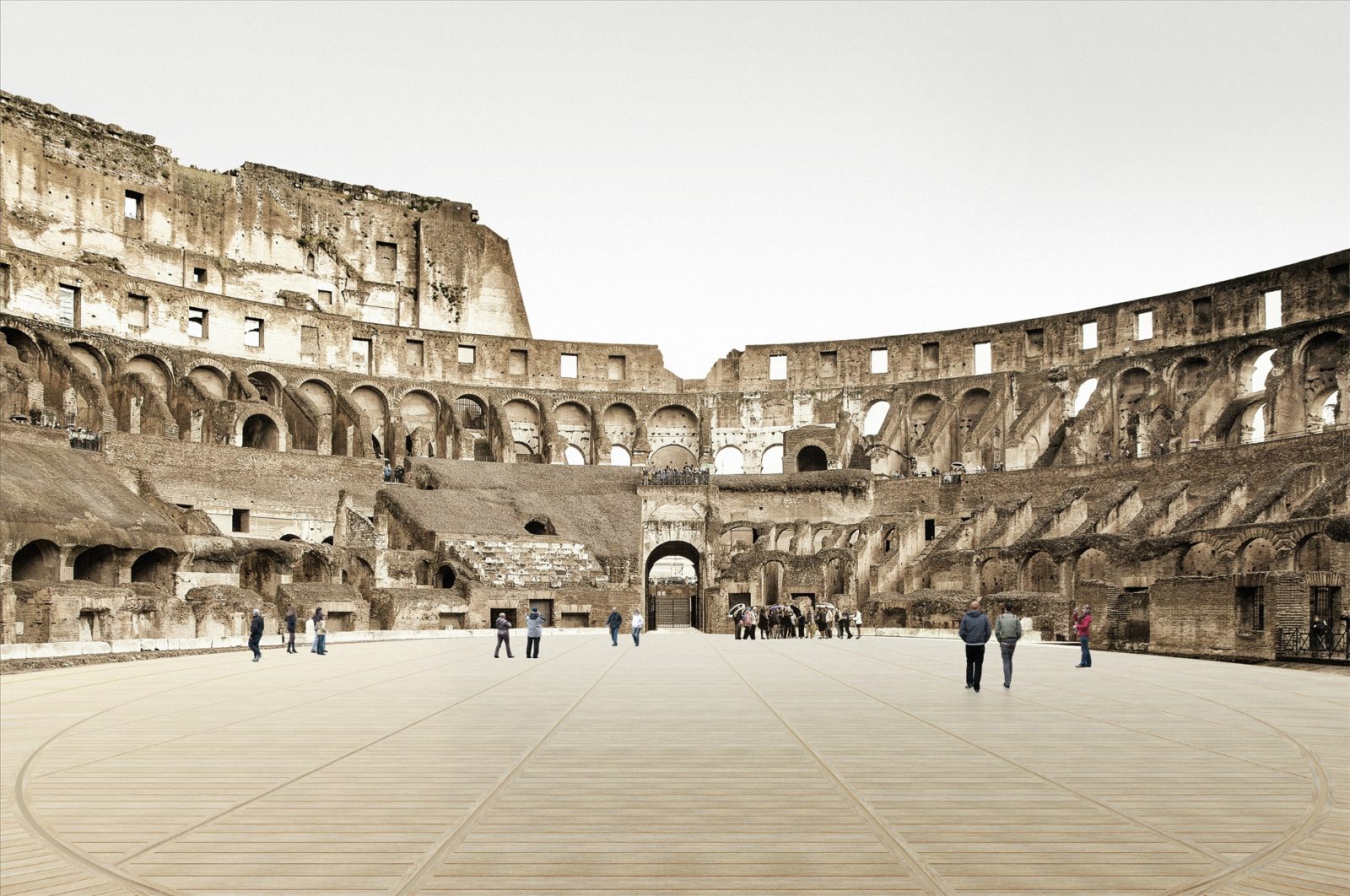
Stand near the center of the arena for a low, symmetrical frame that catches the oval rim, exposed substructures, and the layered seating rising around you. This is the cleanest interior shot on a colosseum private tour, but access depends on the route in use and staff directions.
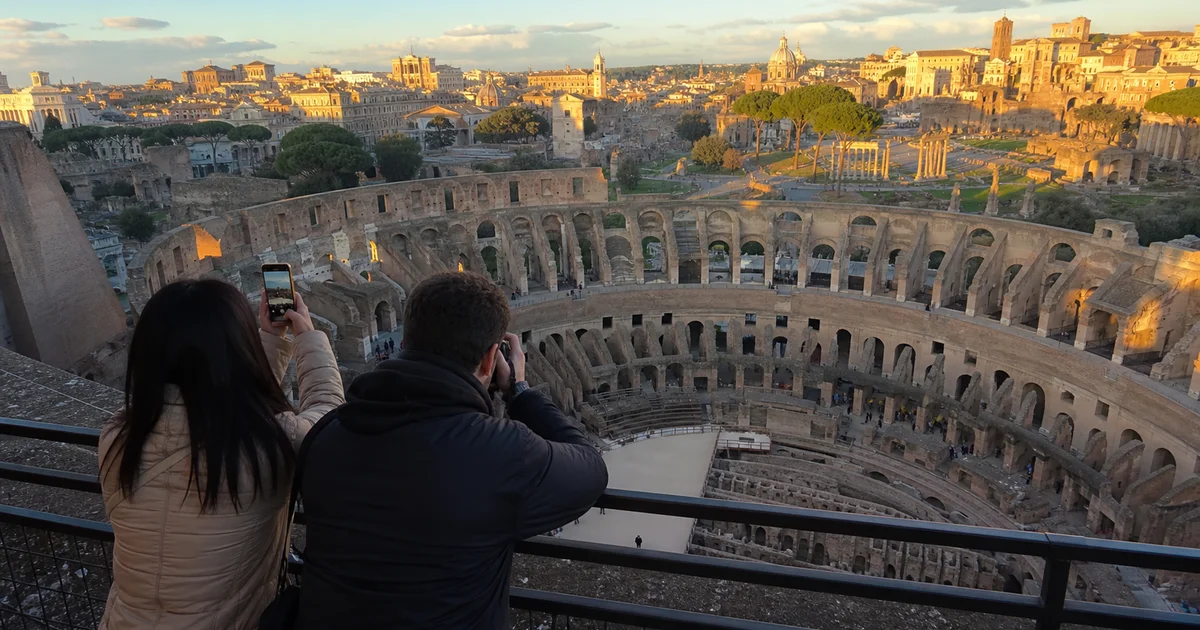
Shoot from the third-level Belvedere Terrace for a wide overlook of the cavea, with the upper orders stacking neatly into the frame. It is the best spot for a big-context image, though you need access to the upper level and should keep back from the railing.
Frame the arena from the southern entrance area where the imperial balcony once had the strongest sightline across the shorter axis. The angle works well for a tight, layered composition, but it is only available on routes that reach the upper interior and southern side.
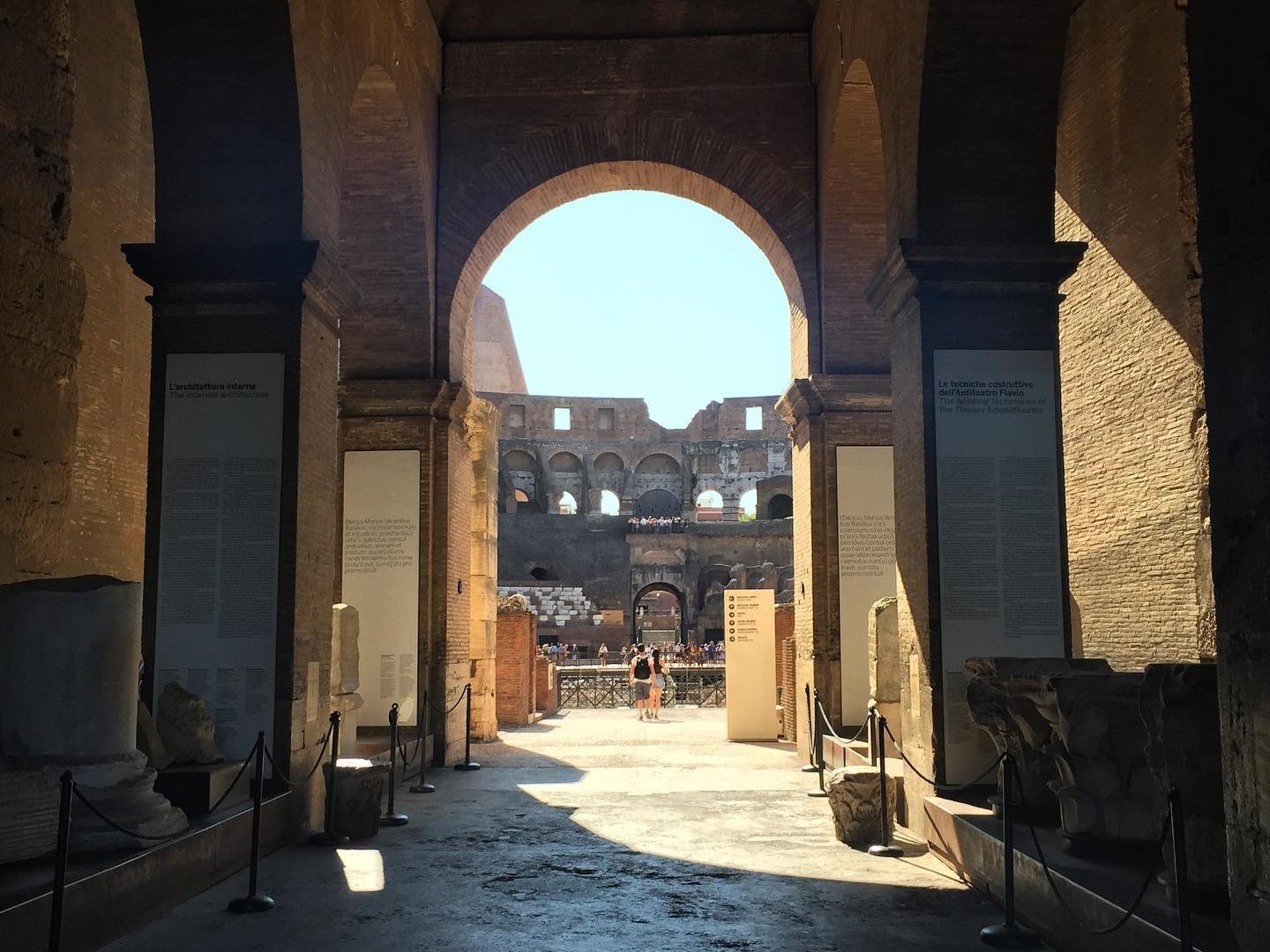
Use the western entrance arch for a strong threshold shot that layers the interior passage, the ancient masonry, and the light spilling in from the outer ring. This is a useful stop on the walk through the monument, especially if you want a less crowded architectural detail.
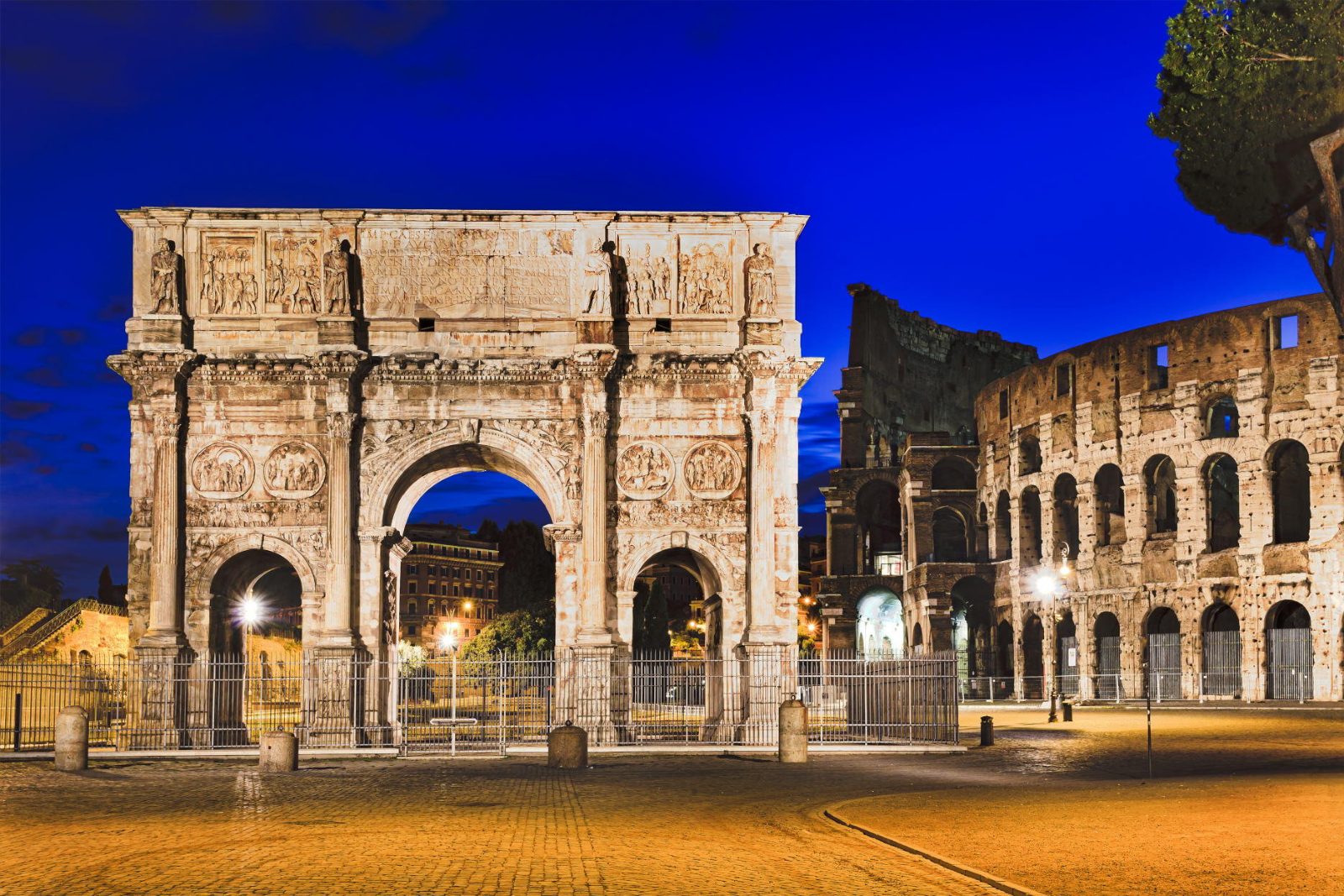
Step back on the approach to include the arch and the Colosseum together in one exterior frame, with the monument rising behind the triumphal gateway. The best composition usually comes from the plaza side where you can control perspective and avoid people crossing the foreground.
Photograph the curved outer wall from the renewed space in front of the south side for a close, graphic view of the travertine arcades. This angle pairs well with a skip-the-line Colosseum tour because you can move quickly between the facade and interior viewpoints.
Real experiences from real travelers
Standing on the reconstructed arena floor while the travertine arches turned amber was the part that stayed with me. Our guide on the colosseum private tour kept the group to six people, so we could actually hear him over the traffic noise drifting up from the road. He pointed out the numbered entrance arches that most people walk straight past.
Roman sun in early June was unforgiving, though the upper tier caught enough breeze to keep everyone going. Our guide linked the Flavian Amphitheatre to the Roman Forum below in a way that finally made the whole valley make sense as one place. Having colosseum private tour tickets sorted ahead of time meant we walked straight to the meeting point instead of hunting for it.
The scale only registers when you stand under the arcade and look up through four levels of stone. Our guide spoke clearly and answered questions about Vespasian and Titus without turning it into a lecture. I would have liked a bit more shade at the meeting point, since May in Rome is already warm by mid-morning.
Rain had stopped an hour before and the travertine looked almost silver in the flat light. A tour privato del Colosseo felt like the right call because our guide could adapt when the weather turned and move us to quieter sections. He also walked us across to the Arch of Constantine afterwards and explained the recycled reliefs on it.
What surprised me was how much of the Palatine Hill our guide folded in without rushing us. The colosseum private tour gave us room to ask about the seating hierarchy and exactly who sat where. Late afternoon light coming through the outer arcade was worth the uphill walk on its own.
Our guide grew up two neighbourhoods away and took us to the Colle Oppio side where you get the full oval in a single look. A skip-the-line Colosseum entrance meant our group stayed together instead of scattering at the gate. Even in February the stone still held some warmth from the afternoon.
January air was sharp and the light was very clean, which made the Forum section feel unhurried. Our guide traced the route along the Via Sacra and explained how the whole valley worked as a single ceremonial space. Of all the Rome landmarks we saw that week, this is the one my kids still bring up.
I live two hours from Rome and had been inside twice before, but never with a guide at this level. She explained the drainage channels and the old awning system in a way I had never heard. Colosseum private tour tours fill up quickly in autumn, so we reserved a few weeks ahead and were glad we did.
August heat radiates straight off the stone in the afternoon, so carry more water than you think you need. Our guide paced things sensibly and used the shaded arcade between stops rather than parking us in open sun. The Rome Colosseum tour also covered the Arch of Constantine and the lower slopes of the Palatine.
Spring light hit the outer wall just as we came around from the metro side and the colour was remarkable. Our colosseum private tour tour guide had a knack for stopping where the noise dropped so everyone could hear without crowding in. The brick channels of the hypogeum below the arena are far more visible than I had expected.
Everything you need to know for your journey
The Colosseum is scheduled to open every day from 08:30 to 19:15 in the current summer season. Last admission is 18:15, so do not plan a late arrival if you want time for the full route.
The official recommendation is to arrive 15 minutes before your booked entry time. For a colosseum private tour, that buffer helps with security screening and finding your guide without rushing.
The official full entry is 18 EUR for a standard adult ticket. Timed entry is mandatory, and sales open 30 days before the visit date.
Yes. The Colosseum has accessible routes covering most of the first tier, and elevators allow visitors with mobility issues to reach the entire second tier. Accessible toilets and wheelchair support are also available in the park.
Security screening is in place at the entrance, and you should keep your ticket and ID ready. Large bags and restricted items can slow entry, so travel light for a smoother colosseum private tour.
Photography for personal use is generally fine in visitor areas, but staff rules can limit equipment such as tripods or flash in sensitive spaces. Follow instructions in the arena, underground areas, and exhibition zones.
Spring and early autumn are the easiest seasons for comfort and crowd balance. Summer can be hot and busy, especially around midday, so an early start is better for a colosseum private tour.
There is no formal dress code, but sturdy walking shoes and breathable clothing are strongly recommended. The site has uneven ground, stairs, and sun exposure, so practical clothing matters more than style.
Small snacks and water are the practical choice, especially in summer. Do not rely on eating inside the monument itself, and plan a proper meal before or after the visit.
The site is at Piazza del Colosseo, 1, 00184 Roma RM, Italy. The simplest public-transport approach is Metro Line B to Colosseo station; parking in the area is limited and urban driving is slower.
Yes, if they are prepared for walking and screening. A colosseum private tour works well for families when paced early in the day, because crowds and heat are lower and rest breaks are easier to manage.
Ticketing is time-slotted, and the official sales system opens 30 days before the visit date. Refund terms depend on the ticket conditions, so changeability is limited once a ticket is issued.
Join thousands of happy travelers who have discovered this incredible experience
Book Your Experience Now